

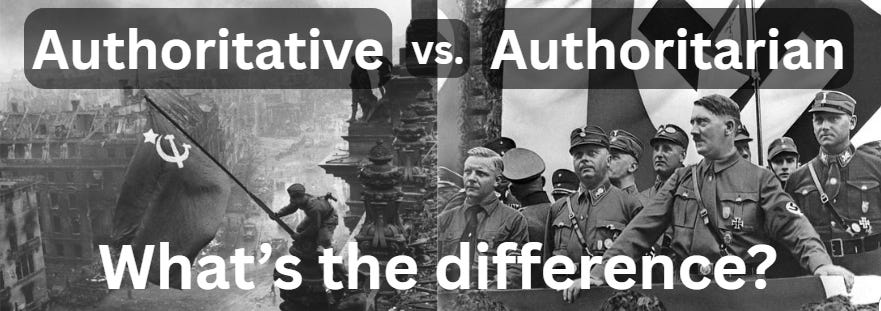
A Note for New Readers: This article uses the Affective Socialization Theory (AST) framework, a neuro-materialist science I am developing to explain how our environment physically shapes our behavior. You will see variables like Material Strain (MAT) and Agency Expectancy (AE) used throughout. If you are new to the theory, you can find the full glossary and research at [Here].
In psychology, affective socialization officially refers to the process by which children learn to process emotions and context from their parents. The sociological framework I have been developing, Affective Socialization Theory (AST), which bridges psychology, sociology, and neuroscience to prove that capitalism is neurodevelopmentally toxic, looks at all sources of socialization, even after adulthood, and how our socio-economic system, the architecture of our society, constantly wires our brains in a certain direction.
With AST’s focus on connecting the micro of psychology to the macro of sociology One of the biggest things that is seemingly of great importance is if a larger sociological apparatus is being “authoritarian.” Now before I lose the people reading this who have red Engels, or maybe are Marxist leninist like me, I just want to say that I agree with Engels and I am not here to say that any socialist revolution or movement that uses the force of authority is authoritarian; rather I am proposing that we as Marxists take on a new terminology and describing this act of taking exercising authority on behalf of the people, as the democratic apparatus representing the people, which is borrowed from mainstream clinical psychology, particularly the foundational 1960s framework of authoritative versus authoritarian parenting styles developed by Diana Baumrind.
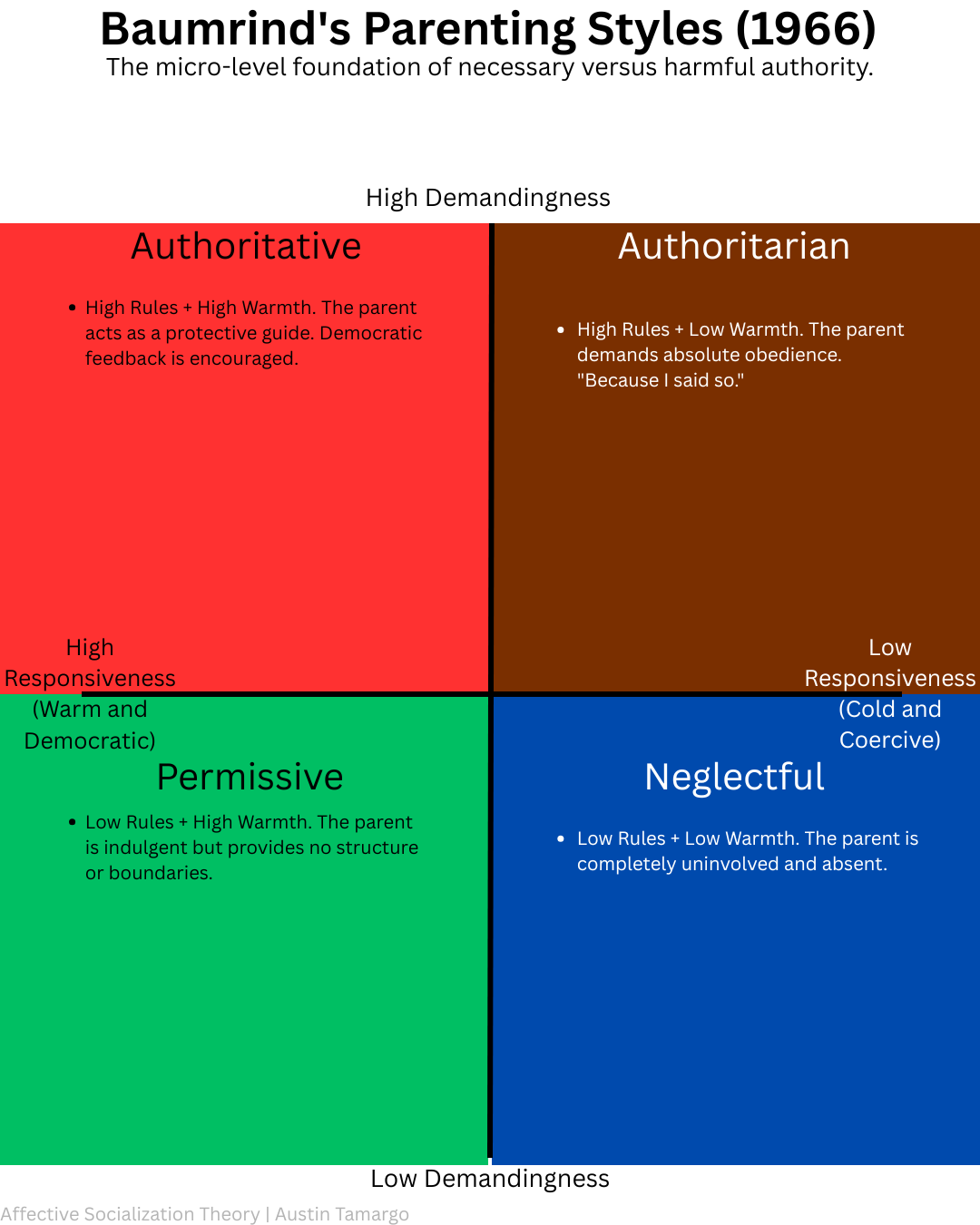
Acknowledging that parenting is a form of early life authority and not only that, but also that it is a necessary authority and combining that with the scaling from micro to macro and the transition to adulthood whereby the state practically becomes the supreme material authority over an individual; AST proposes that there is a difference between authoritative and authoritarian governments, revolutions, and social movements in general. The reason it is necessary for us as Marxists to take on this new framing is the same reason it is necessary for psychology to make a distinction between these two forms of parenting: because all authority is not the same. Authority on the basis of enforcing authority over others in itself, authority being the end goal, is authoritarian. Authority that is exercised democratically for the benefit of those who are under the authority is authoritative. In a socialist context this authority is democratically decided by a working class democracy but for all general context authority that is exercised in the benefit of the people the authority is over is authoritative. Just like whenever we must give rules to our children, responsible leaders must make laws for a population for their safety. And even in a revolutionary movement or even in a community organization, the group must have rules that are enforced by some kind of leadership, which can expel people who do not abide by those rules, so that the relationship can be mutually beneficial for the members and the authority.

Engels was right when he wrote about how authority is inherent in a revolution, and so the word authoritarian as a slur against revolutionary movements of the masses is incorrect. However, since Engels’ time, not only have we seen the rise of fascism, but we have also seen the rise of other movements using the symbolism and vocabulary of socialist movements to gain political power and then become something that is not at all aligned to what we as socialists are trying to achieve. This same old argument we Marxists use today was originally put forth by Engels at a time period when this word, authoritarian, was predominantly used as slander against socialists. It didn’t have the real-world context of later regimes like those of Nazi Germany and the Khmer Rouge to compare to socialism and say these are the same thing as socialism, and try to portray their ideologies as the same as socialism. The historical situation has now evolved, and we have to redefine and re-address the concept of “authoritarianism” to be able to be better understood by the masses.

My case in point: A little while ago I saw that the channel Second Thought on YouTube had put out a video and which was titled “we need to talk about authoritarianism” and basically the video was a basic Marxist critique in the same style as Engels gave of the word authoritarianism and how all revolutions are inherently authoritarian; you know, the same argument we all as Marxist have basically been trained to use. There was a lot of reaction to this from different parts of the left and other people on the political spectrum, and to these people, just denying the existence of authoritarianism creates confusion because what they’ve learned about what authoritarianism is. They have learned through socialization from school, popular media, or other sources that authoritarianism is what the Nazis did, what the Khmer Rouge did, and of the horrors it has caused. Not only that but they have also learned through propaganda (even some that originated from places like Nazi Germany) that the Soviet Union, China, and other socialist states also commit this authoritarianism, and if as socialists our best defense to that is to say that authoritarianism is just buzzword used to de-credit revolutionary movements and don’t push our analysis further and outline what separates socialist authority or the socialist state using authority from a state or a regime using the language of socialism or just a regime in general being authoritarian (you know, exercising authority for the sake of exercising authority itself for the maintenance of that power and that authority), then we keep giving those who propagandize against socialism an easy way to make us look bad by cherry picking our words and turn people against our ideas before they even hear us out.
I am all for being a principled Marxist-Leninist, but at a certain point, relying on Engels’ 18th-century critique becomes dogma that, as time goes on, becomes more and more obscure to the masses. Yes! I love Engels’ article “On Authority!” It should definitely still be read in historical context, but if we are really seeking to “bring class consciousness to the masses,” we have to update our scientific analysis. Since Engels’ time we have seen the rise of movements that used socialist language and were authoritarian (like Nazi Germany and the Khmer Rouge) and developmental psychology has identified a difference in necessary, even beneficial authority and unnecessary, harmful authority; these two understandings lead us to a historical, cultural moment where if one denies the word “authoritarian” as a meaningful descriptor, the general public who is not educated in Marxism will most often assume your overall position is either one of delusion or apologia.
So us solely denying that the word applies to our movements and not giving a deeper analysis of the concept itself can shut the ears of the modern masses before our deeper analysis can be heard. When we try to say the movements that use our language are not us, on this basis, we often explain that these movements are fascist, counterrevolutionary, or opportunist, and we do provide evidence that these movements objectively operate differently than our movements, but it takes time for someone to go through all that research, or even piece it all together sometimes.
With all this in mind, I am proposing that there’s a better way that we can define these types of governments that more closely aligns to the modern understanding of these words and can give us better ideological armor against these attacks. With this new framing we can say no, the Soviet Union, Cuba, China, etc, were/are not we’re not authoritarian but the Khmer rouge was; and not just subjectively, I have proposed as part of the sociological framework I am developing, AST, a formula that we can use and test against different regimes to determine which category they would fall into: authoritative or authoritarian. This is called the revolutionary pathology quotient.
One of the core variables in the RPQ formula is the material strain. The material strain is not just a measure of objective material strain that the population is experiencing under the regime or revolution but also of the subjective strain felt from that objective strain and this is done in an intricate way that is still being developed and hasn’t undergone testing yet but you can see more about it here. Anyways the point is after that this material strain is separated by endogenous and exogenous, meaning is the material strain imposed on the population by the current authority and power by their direct intent and action or is it the result of a blockade, sanctions, or imperialist aggression and encirclement? The next key variable is determining whether the regime or revolution is building Collective Agency Expectancy: are the people constructing and participating in democratic processes, being empowered and building a sense of agency that’s tied to their community? This represents scientifically that the socialization of the environment is training the nervous system of the members to actually cooperate and communicate with others, better fostering the green zone that AST talks about on a collective level.
The math is still being developed but here is the relevant variables and formulas as they currently are in development:
The Revolutionary Pathology Quotient (RPQ) formula mathematically isolates the origin of a society’s material strain and the way it directs agency to determine if a force of authority or group is authoritarian or authoritative; this is scientifically based on the affective socialization hegemonically produced by the relationship between material conditions and agency expressions.
Before we can calculate the RPQ, we have to measure the material strain of the population, which would come from aggregated scores, similar to indices already in use to measure material suffering or security.
The Material Strain Index (MAT)
Material strain is not just an objective lack of resources; it is how that lack biologically taxes the nervous system. The MAT formula calculates this by combining objective deprivation with subjective worry:
MAT = (MAT-O * 2) + MAT-S
MAT-O (Objective): A score from 0 to 7 based on severe deprivation in foundational categories (housing, food, healthcare, debt, transportation, income, utilities). It is multiplied by 2 to mathematically prioritize physical reality.
MAT-S (Subjective): A self-rated stress score from 0 to 10.
AST hypothesizes that there is a critical biological threshold which is currently proposed as a score of 15. When the scores of the population cross this line, their nervous systems lock into survival mode. The prefrontal cortex is overridden by the amygdala, and complex social cooperation and higher learning (the Green Zone) shuts down.
Exogenous vs. Endogenous Strain
To objectively judge whether a state (or any force of authority) is authoritative or authoritarian, the RPQ looks at where this material strain is coming from:
Exogenous MAT: Strain forced upon the system from external structural violence (capitalist embargoes, imperialist encirclement, foreign-funded civil war).
Endogenous MAT: Strain artificially engineered or deliberately exacerbated by the state’s own intentional policies.
If a socialist state is managing a massive external crisis (Exogenous MAT) and enforcing strict rules to distribute resources fairly and make sure everyone has the highest chance at survival and relief possible, it is acting as a protective scaffolding. It is engaging in necessary protective measures, just like an authoritative parent would to protect their children. This is what AST calls Affective Triage: the necessary, emergency management of resources to secure their material needs and psychological well-being.
If the state itself is manufacturing the crisis (Endogenous MAT) to demand absolute obedience and destroy democratic feedback, it is a pathology.
The Revolutionary Pathology Quotient (RPQ)
We combine the engineered strain with the social character of the environment to calculate the final diagnosis:
RPQ = Strain Shift * (Coercive CCC Index / Collective AE Index)
The math asks two measurable, falsifiable questions:
Is the state manufacturing its own scarcity? The Strain Shift compares the state-engineered Endogenous MAT against the historical baseline of the pre-revolutionary society. External attacks from capitalists do not count against the revolution here.
Is the environment coercive or cooperative? This measures the ratio of the Coercive Class Character of Context (CCC) against the population’s Collective Agency Expectancy (AE).
The Boundary of Authority
This formula can hopefully be a starting point for ending the subjective debate of authoritarianism with a proposed mathematical boundary, dependent exactly on the actual material conditions and effects of the authority apparatus. The math is formulated here as it was initially, for revolutions specifically, but it theoretically could apply more broadly to any authority apparatus; though it may have to be conceptually reworked for other applications.
The Authoritative State (RPQ < 1.0): If the RPQ remains below 1.0. The math shows the state is successfully mitigating external strain while ensuring that collective agency heavily outweighs top-down coercion. It is a healthy, necessary protective mechanism for ensuring the well-being and will of the people.
The Authoritarian State (RPQ > 1.0): If the RPQ crosses the threshold. The math shows an authoritarian turn. The state apparatus is now manufacturing more endogenous strain than the historical baseline, and that top-down coercion has successfully eclipsed the collective agency of the working class. The state has drifted into pathology; it is not healthy.
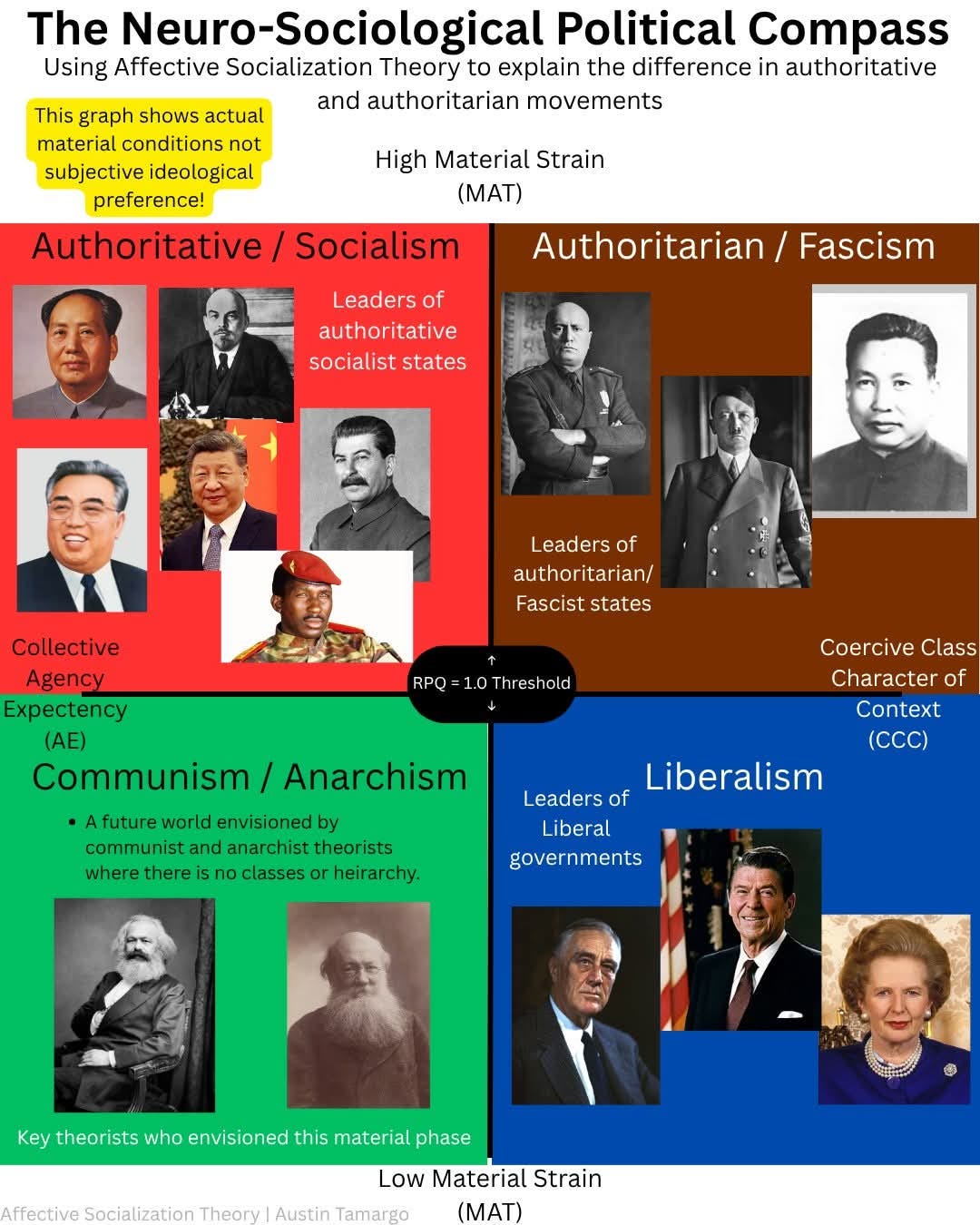
The math ultimately proves the core neuro-sociological truth: actual socialist states are authoritative, and Fascism is authoritarian. Also, note the wording here, “socialist states.” This math is not ideology-dependent; it is empirical dialectical materialism. With the conclusions of this math, states like Libya under Gaddafi (which made basic necessities like food and housing a human right, and set up institutions built on direct democracy) would also indeed be considered socialist states, even if it is not a “traditional Marxist-Leninist state.”
We no longer need to rely on 19th-century vocabulary to analyze modern revolutions. With the RPQ, we have not only a mathematical backing for calling actual socialist states “authoritative,” but also a tool to ensure our movements remain forces of liberation rather than new architectures of oppression. This math takes what we have already been saying as Marxists, grounds it in the science of Affective Socialization (which is a field itself beyond my AST theory), and gives us something we can use as social scientists to see if our movements and others are living up to the defining factors of what socialism actually is. The improving of the material conditions of the masses and construction of truly democratic institutions of the working class like Michael Parenti outlined in his works like “Blackshirts and Reds.”
Dive into the full AST framework (still in development) on my website here: Affective Socialization Theory
References
Baumrind, D. (1966). Effects of authoritative parental control on child behavior. Child Development, 37(4), 887-907. https://doi.org/10.2307/1126611
Tamargo, A. (2026). Affective Socialization Theory: A unified model of behavior (Part 1: Neural wiring & the recursive system). Zenodo. https://doi.org/10.5281/zenodo.18514658
Thank you for your feedback and criticism my friend I promise I will give you a reply that addresses your concerns. But yeah, This is the article that I made a political compass for as a visual hook just because I thought it would start the discussion on Facebook and I had a few people who I thought were my actual friends come out and attack me over it so I mean basically most of them were just judging based on the graphic I don't think any of them actually read the article