

A Note for New Readers: This article uses the Affective Socialization Theory (AST) framework, a neuro-materialist science I am developing to explain how our environment physically shapes our behavior. You will see variables like Material Strain (MAT) and Agency Expectancy (AE) used throughout. If you are new to the theory, you can find the full glossary and research at [Here].
Growing up in a conservative North Carolina town, I was taught early and consistently that communism was basically an ideology of authoritarian, totalitarian government power. I was taught that it shared this trait with fascism and Nazism; that they were all different forms of the same strict, absolute power over political decisions.
I was also socialized into desiring power, as all of us are who are born under capitalism. I even told my parents when I was in elementary and middle school that I wanted to be the emperor. That was my dream. I think when I first got to high school, I told them that I hadn’t given up on that. They told me I had to be realistic, and I said that I saw so many problems in the world, and I felt like if I could wield absolute power and have total say over political decisions, it would be easy to make the right choices and just fix everything. Throughout my childhood, I would talk about what I would do for the people, and how I wanted to make sure everybody had a house and food and was taken care of. I don’t think I’m the only one who has had thoughts like this, especially as a child born under capitalism.
When I was 17, I traveled the country hitchhiking and hopping on freight trains. I embraced a hippie lifestyle, trying to be humble, focusing only on the positive, and seeking peace in all things. At this point, I had been convinced that the problem wasn’t that we didn’t have enough stuff, it was just that people were fighting too much since they had been misdirected by toxic culture. I thought we just needed to heal. I had dreams of being a great musician like Jimi Hendrix. I thought if I could just make great music, I could influence the world and start a new hippie movement like the ‘60s. We could all embrace each other in a new movement of love and understanding, and society could be a better place.
By the time I was 21 years old and decided to read The Communist Manifesto for the first time, I had already come to an understanding that to succeed in this society, I would have to be ruthless. I saw a statistic once that stuck in my mind as a teenager, which said that a large percentage of successful people, like CEOs and people in high positions of power, have antisocial personality disorders. At the time, I knew this as being psychopaths, sociopaths, or narcissists. I took this information to mean that to succeed in this world, I had to be ruthless and completely selfish. I had to take advantage of whoever I could to get what I wanted, since that is how the world we live in works.
I thought if I adopted this mentality, I would surely rise in the ranks of society given that I had such great potential; everybody always told me I was smart. So, after a few years of trying to do what I could, getting arrested for selling drugs, spending 5 months in jail, and then two and a half years on probation, I came out and started doing hard labor. I was doing framing and roofing, landscaping, and other manual labor work. Going through that hard labor all day, every day, and having to get up the next day to do it again, I came home so tired and worn out that I didn’t have any time for my music or for any of the creative pursuits I really wanted to do to prove that I was somebody.
After realizing that, I slowly just stopped caring about priorities. I completely stopped worrying at all. I quit going to work if I didn’t feel like it. I gave up. I couldn’t pay the rent, I got evicted, and I eventually ended up being homeless on the streets again.
My mental health got a lot worse. For years I had studied occult knowledge, spiritual mysteries, and other philosophies to try to find an answer, some kind of intellectual edge that could help me step up in the world and secure a better life. So, it was at this point, while I was homeless, that I would stay in a local gym in my town at night. Nobody really went there, so I would just hang out inside since I had a membership. I was sitting there one night, and I started listening to the audiobook of The Communist Manifesto.
The reason I even listened to it in the first place was desperation. My whole life I had learned it was evil. Having always held a belief in God and good and evil, I thought if I ever went down a path like that, my soul would be doomed to hell. If I ever became a Nazi or communist or anything extreme, my soul would be damned for participating in something I knew was evil. For that reason, I never dared read anything from a communist. At this point, however, I felt I had no other options. I was desperate for any tool that could give me power. Recognizing the absolute totalitarian power that was portrayed to me growing up around a white nationalist step-family actually made me more curious about it.
I decided to read it knowing I didn’t care anymore if my soul would be damned. I told myself that escaping this suffering and depression, and finding security no matter the cost, would be worth at least examining all sides. I always considered myself intelligent for being objective, so I decided that even if I didn’t fully become a communist, I could still use their tactics. I thought, if this is an ideology that leads to people becoming totalitarian autocrats, then reading it should be just like reading The Prince by Machiavelli or The Art of War. I could read it to gain insight into power and learn how to manipulate it for my own benefit.
That was my mindset going into The Communist Manifesto. Yet after spending about an hour listening to it, I was blown away.
I realized that this was not evil. Regardless of the “Communist dictators” I had heard about (whose legitimacy I was now objectively questioning), what this book was actually saying was that we can make the world better for everyone. It made my striving for power meaningful. It taught me that as an oppressed person facing the coercion of capitalism, it is natural for me to desire a better position for myself. The key thing, however, was this: the best way for me to secure that power and safety is through a collective effort. I had to collaborate and cooperate to achieve liberation for us all.
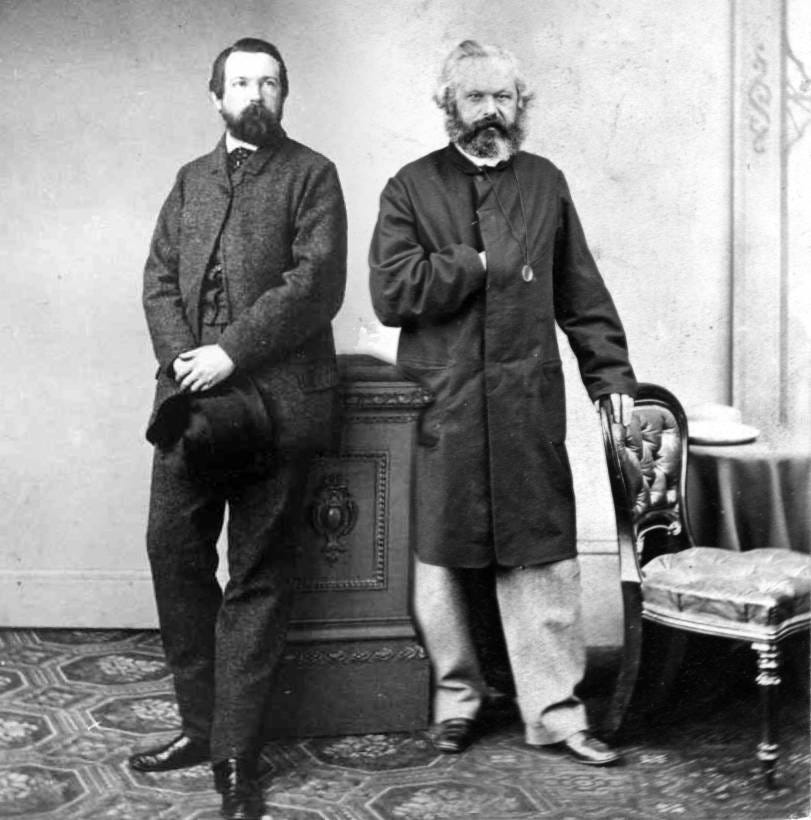
This was so powerful to me. After reading more writings from Marx, Lenin, Stalin, Mao, Che, and other revolutionaries, I saw how they theorized. They became honored for the intellectual labor they did, and they became leaders. I thought to myself that this could be an honorable path for me to actually be a leader, not in that juvenile sense of being an emperor from when I was a kid, but being an intellectual leader who proposes theories and plans for the collective liberation of the masses.
Still, I felt guilt for this desire. I knew within myself that it was probably a common ambition, especially for someone like me who had trained himself for years to try to disregard feelings and be completely cold and calculated in order to survive. Today, I know the reality is much more structural. Getting into those positions of power structurally makes people act that way, and simply adopting an antisocial personality disorder doesn’t guarantee you’ll get rich. However, I had this lingering feeling that if my personal desire for power and safety came before my revolutionary work, it could be corrupting. I told myself that my desire to be the best revolutionary made me want to be the most principled revolutionary, serving as an ideological fail-safe.
My friends, if you have read all that and you’re wondering if it’s just a rant about my life, I’m telling you that this is where we get to the point: Ideological purity will not stop anyone, even the most principled, most studied, and trained revolutionary theorist, from inserting their own bias for the security that power gives, unless there are structural mechanisms in place to not allow it to happen.
This is a brief explanation of what we will be going into today, and it is all grounded in the sociological framework I have been developing that bridges neuroscience, psychology, and sociology: Affective Socialization Theory (AST).
With the formulaic connections this theory empirically outlines, we can actually explain what drives a great revolutionary theorist, their true role in the dialectic between the individual and society (without devolving into Great Man Theory or pure structural determinism), and finally, why some of those who claim to fight for a noble cause can become paranoid and drift toward authoritarianism. And to be clear, this does not mean authoritative (exercising democratic authority for the benefit of the masses), instead it refers to authoritarian (authority that is not democratic and exists solely to uphold itself), a distinction I broke down in a previous article.
Under the coercive architecture of capitalism, the working class is subjected to artificial material strain, or Exogenous Material Strain (MAT), occurring as a direct, intentional action of the authority in power. Meanwhile, this same ruling class continuously tells the population that it’s in their best interest to keep serving the system creating that strain. When a person is educated with class consciousness, or develops the internal context framing to understand the nature of the oppressor and oppressed relationship, it causes cognitive dissonance.
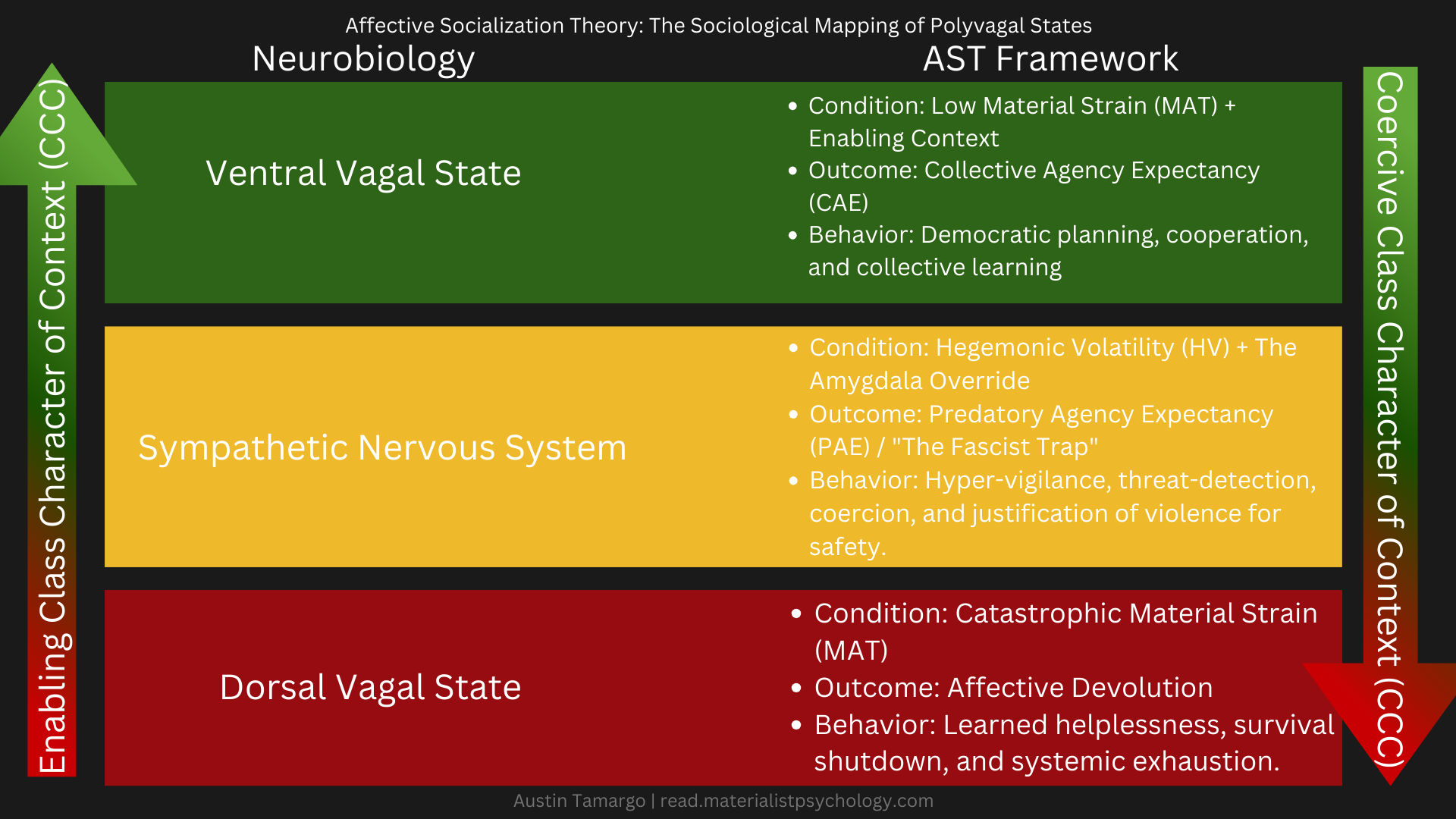
The volatility and insecurity of this environment has a macro-sociological effect: it causes neural responses to default to a sympathetic (fight-or-flight) or shutdown state. This overarching cultural hegemony creates a “Yellow Zone” response.
Recently, another theorist developing their own framework, Michael Thony, reached out to me. He explicitly outlined misinformation as an “environmental toxin” which destroys epistemic care and breaks down the cooperative potential of society. I agreed with this immediately. It made me realize that misinformation is the primary weapon capital uses to redirect that Yellow Zone sympathetic state. It is all about divide and conquer. I am helping him create a substack more people can see his work, and when he does I will update the article tag him here.
When you have that internal context framing that allows you to see the oppressor/oppressed relationship (class consciousness), the brain recognizes that the threat is not a physical thing that can be punched or outrun. Instead of pushing you into a mode to attack an innocent victim or do something irrational, the brain triggers you to try to map out the structural threat.
When the material strain becomes so great that a threshold is reached, a person can experience an amygdala override. The threat of complying with the oppressive authority becomes perceived as worse than the threat of fighting it.
This state is called Hyper-Vigilance Pattern Recognition. The brain frantically attempts to build a complete map of the current circumstance, examines all the possibilities to fix it, and analyzes the dialectical relationship between those possibilities and reality.
The key thing about this type of thinking is that it actually supercharges intelligence. It initiates a process of Affective Myelination. Every time a theorist successfully synthesizes a contradiction or discovers a new dialectical concept, the brain rewards them with dopamine. This creates a biological positive feedback loop. The more you theorize to survive, the more physically dense and efficient your systems-thinking neural pathways become. You literally supercharge your own intelligence through sheer revolutionary necessity.
The Receiver and the Prophet
Human society operates as a massive, interconnected biological organism. When this organism encounters a lethal structural pathogen like late-stage capitalism, it manufactures specialized nervous systems to identify the threat.
Think of the concept from The Giver, where an authoritarian society requires one person, the Receiver of Memory, to bear the entire cognitive and affective burden of humanity’s past. While the film adaptation distorts this through an individualistic, capitalist lens, the core premise perfectly illustrates a real-world dynamic. The revolutionary theorist is the real-world Receiver. The masses, crushed by survival exhaustion in the Red Zone, do not have the metabolic energy to map the invisible systems oppressing them. Out of pure neurobiological necessity, the social body produces the theorist to act as its specialized processing core. This person accesses the collective memories of humanity to offer wisdom based upon how that history relates to current struggles.
As we see in the story, the Receiver wakes up to the lies of the system once exposed to this history, attempting to bring class consciousness to the rest of society. The important thing to note here is that this understanding comes with great anxiety. The deeper the theorist’s knowledge gets regarding how structural systems apply to their current situation, the more chaotic and intense their internal experience becomes. What is the objective, empirically observable phenomenon which this story tries to metaphorically conceptualize?
First and foremost, this ability to access the history of the world and have this vast expansion of knowledge was gatekept by the ruling class for many societies throughout known human history. Today, we have a historic opportunity as the masses to utilize the education available on the internet. This power to understand the collective memory of humanity, and the necessity of our current struggle, is available to anyone. While the movie gives an extreme case version based in capitalist culture of the one lone hero, I believe the phenomenon shown in the movie is actually an environmentally induced Hyper-Vigilance Pattern Recognition. When the brain understands the dialectical process of material reality influencing our ideas, and those ideas going back to reshape reality, it invokes a sense of historical urgency that many communists and anarchists share.
The constant awareness of the macro threat of the capitalist system puts that context framing in your mind. Dwelling on it forces your brain into the Yellow Zone, which is built for threat detection and competition. When it is used to map out dialectically how these structures can be changed, it becomes Hyper-Vigilance Pattern Recognition. Because it is so emotional and deeply felt, this only strengthens the neural connections that form. This is how great theorists are made.
It is important to point out the crucial factor here: this is a form of cognitive processing, and therefore a behavioral output, of the Yellow Zone. Since the Yellow Zone is built for fight-or-flight survival and competition, a theorist must spend enough time cultivating Green Zone microclimates in their own life and in their community organizations. They must be part of a cooperative context that enables Collective Agency Expectancy for its members. While the threat detection of the sympathetic nervous system can be a very powerful tool, if it is not combined with healthy doses of the Green Zone, it will breed paranoid, competitive, and eventually coercive behavioral output.
In On the History of Early Christianity, Friedrich Engels explains and gives historical evidence to the fact that all religious and spiritual movements started as socioeconomic movements of the oppressed. We know today that these movements are eventually co-opted by those in power and just become another tool of their oppression. But why does that happen?
Historically, there are multiple case studies showing that the greatest religious leaders that appeared in early human history, like Buddha, Jesus, Muhammad, and many others, taught a message of peace and love. They actively taught their followers to do rights and rituals that created temporary Green Zone microclimates. However, they also utilized a strategic use of the Yellow Zone energy, mapping out the structural reality of the oppression their people faced. They channeled that sympathetic nervous system energy into constantly fighting that threat.
Whenever a threat is not physical, you cannot punch it. You have to understand how it works. When the threat is the environmental order being imposed upon the nervous system itself, blocking its evolutionary ability to maintain a Green Zone neural state, our powerful brains have the ability to actively engage in an intellectual fight. This is what we call ideological struggle. It is not only this inner ideological struggle of mapping out the system to regain agency, but also the practice of deploying that action into real-world organization with other people. This practice then shows what ideas were correct, what was wrong, and what should be done away with, as described by the Marxist school of thought.
Maintaining a focus on creating Green Zone microclimates while actively using the structural mapping of Hyper-Vigilance Pattern Recognition is what I would call an art. It is much different from the concept of ideological purity. It is recognizing that channeling anxiety constantly without substituting it with healthy doses of the Green Zone neural state will eventually create a predatory neural baseline, or at least a paranoid reactive one. Furthermore, that worked-up Yellow Zone energy will eventually cause a Systemic Integration ($\Delta$MSI) crash, since the inherent volatility of the fight-or-flight response creates an unstable mood.
The people in history who learned to use this Hyper-Vigilant Pattern Recognition along with a continued cultivation of Green Zone microclimates were able to become what AST calls an Affective Conductor.
The Affective Conductor is able to truly synthesize the historical position and provide a believable trajectory that feels innate because it connects deeply to our neurobiology. It becomes more than just mapping out current societal forces. It becomes an analysis of the self in relation to that society. Through that process, a universal human experience emerges: our collective future depends on the cultivation of Green Zone environments which enable us to operate in solidarity, cooperation, and higher social learning.
This gives us the ability to ensure our survival and actually work together as humanity to create the best solutions for the climate crisis we currently face. The historical urgency felt by the leaders of these different movements throughout history was a real, necessary thing. Our bodies specifically evolved to have this Green Zone neural state. As Peter Kropotkin outlined in his book Mutual Aid, cooperation among members of a species is a defining phase in evolution. Working together equitably to solve our macro-level problems with solidarity is not just urgent today because of the looming climate crisis and constant wars. It is urgent because the structural systems currently in place are causing the majority of people on the planet to operate strictly in the Yellow Zone, or in a state of Commodified Agency Expectancy.
The Affective Conductor taps into this neurobiological truth through a process of dialectical discovery. When they communicate this with the oppressed masses, it resonates with them because it is an accurate reflection of their lived experience. Even if the conceptual explanations were based on mystical forces like gods or devils, as they often were in the past, the structural mapping of reality and the contradicting dialectical forces all around them were understood and explained by people like this.
Prophets were simply early Affective Conductors. They absorbed the Hegemonic Volatility (HV) of the traumatized social body, processed it through their supercharged intellect, and reflected it back as a unified path to salvation.
A revolutionary vanguard using democratic centralism, as outlined by Vladimir Lenin, is an organization specifically made to consist of these exact types of people. While Lenin called them professional revolutionaries, AST would call them Affective Conductors. This does not mean that all of them had achieved the art and skill of synthesizing the Green Zone microclimate experience with this Hyper-Vigilance Pattern Recognition.
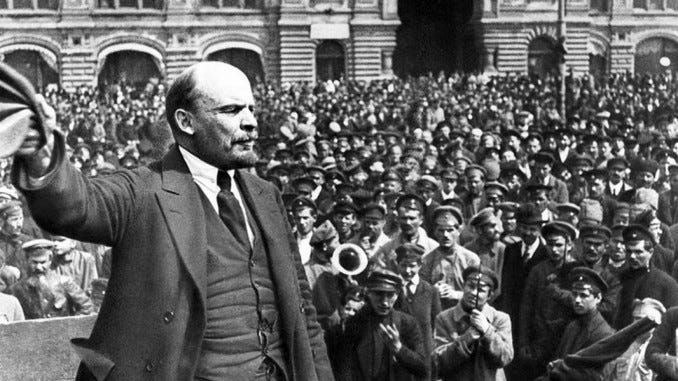
People like Lenin and Stalin were undoubtedly professional revolutionaries who I respect and appreciate for the work they did. The fact is that they were heavily influenced by their environmental circumstances. They were socialized into consistently maintaining a sympathetic nervous state of fight-or-flight, and they built a cultural belief that this state was preferred. They neglected the cultivation of the microclimate Green Zone experience which allows the nervous system to access the feeling of social connection, rather than just the cold, calculated, scientific understanding of it. Being part of healthy, enabling Green Zone community organizations is vital because this is what keeps the brain in a state of remembrance of cooperation.
AST outlines how human behavior is an output of these different neural states. If the Yellow Zone neural state produces specific hyper-vigilant, reactive, competitive responses, it can indeed be used to continuously fight the oppressor intellectually. However, it becomes continuously harder to upkeep the remembrance of that feeling which motivated the collective goal of liberation in the first place. Without that initial Green Zone inspiration, revolution just becomes a desperate, and in some cases very effective, way of ensuring personal power, seeing as power is the ultimate security.
I am not going to sit here and say in this article that Lenin or Stalin specifically did this or that, at least not without direct evidence. I do think a more thorough examination of specific factors like this can be productive to understanding where previous revolutionaries went wrong. When I think about this, I think about Mao Zedong’s critique of Stalin. Mao said Stalin undoubtedly was a great revolutionary who served the international working class and defeated fascism, but he created some dialectical errors. Mao talked about how the repression of the Soviet people was one of those errors. Even though some counter-revolutionaries were rightfully dealt with by the hyper-vigilant state apparatus that Stalin helped create, embedded in that system is the possibility for abuse of power due to the implemented hyper-reactive response against anyone perceived as a threat.
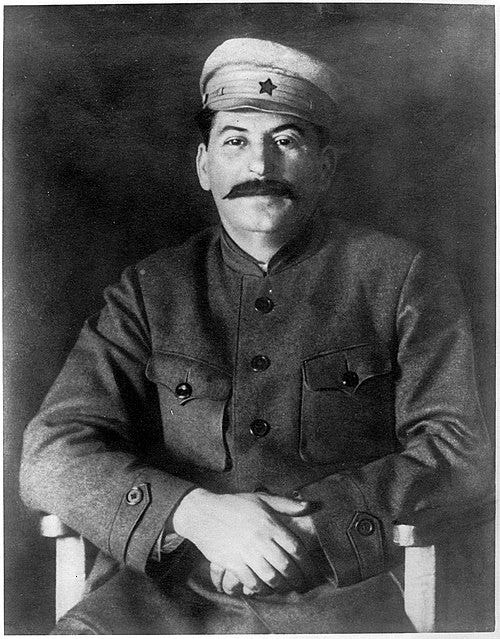
Mao Zedong examined the lesson to be learned from this: there is a difference between contradictions among the people and contradictions among the enemy. The way we handle a citizen protesting the government or doing something perceived as a threat to the overarching socialist project should never be dealt with using violence or force unless they become a direct physical threat to others. Contradictions among the people are handled through democracy and education, not coercion. Only in the struggles against the enemy must we use force.
After these true artists die and are replaced by others who take over the organized structure, a problem arises. When the new leadership takes over, if they haven’t been skilled in the exact science of balancing these neural states, they are doomed to drift the movement itself. They will create a Hegemonic Mood Climate that fosters Predatory Agency Expectancy, ultimately creating a coercive Class Character of Context which results in an authoritarian organization.
I am not saying that there has never been an extended period of successive leaderships in human history just because they didn’t have this exact math. The beauty of human experience comes from seeing how different cultures dealt with this problem, what types of structures they tried to create, and how different material conditions created different types of struggle. What I am saying is that the math of Affective Socialization Theory measures these different variables. Once AST empirically validates the relationships of these variables, we will have undeniable science showing us exactly how to avoid the authoritarian trap.
Beethoven and the Suppression of the Green Zone
I said earlier that I was not going to say Lenin or Stalin did this or that without evidence, and so I would like to present this key piece of evidence that directly points to the overarching concept I am trying to convey. We have historical proof that the vanguard actively suppresses its own neuro-affective health to wage revolution. There is a famous conversation recorded by Maxim Gorky where, after showing Lenin Beethoven’s Appassionata sonata, Lenin remarked on how beautiful and powerful the music was. He noted how it made him want to say sweet, silly things and pat people on the head; he immediately followed this up by saying that he cannot listen to music like this too much, or listen to music at all much these days, since he has to be vigilant. Basically, here is what he said:
“I can’t listen to music very often, it affects my nerves... Today we mustn’t pat anyone on the head or we’ll get our hand bitten off; we’ve got to hit them on the heads, hit them without mercy, though in the ideal we are against doing any violence to people.”
Now, I know this is another person saying that Lenin said this, and we can never really know the exact truth of it; however, it is a well-cited and accepted quote that many people attribute to him. Furthermore, his writings and work suggest that he saw the revolutionary readiness and the professional nature of being a dedicated revolutionary as very serious. Lenin did have his own localized micro Green Zone climate with his wife and with other comrades when he was with them, as well as during other times when he spent time in nature. He did have to face exile, however, and at times was very isolated from the working-class movement he informed; consequently, that level of cooperative social learning inherently necessary for a socialist movement was understood by him perfectly. The way it was set up, however, was done in a hyper-vigilant way. This is not any kind of bad remark on him, as he was an individual who existed in his historical and cultural context, which socialized him to see the historic necessity of that hyper-vigilance.
The concepts of the revolutionary vanguard and democratic centralism have historically shown to be correct in seizing and establishing a new type of socialist power; this is why there is the famous quote that says once you learn a certain amount of history, you either become a Marxist-Leninist or a liar. Myself being one, I can tell you for sure that we take immense pride in this historical validity and the reproducibility of our methods. Many of my Marxist-Leninist comrades, even to this day, cannot reconcile with the fact that there is something wrong or some correction that needs to be made to Marxism-Leninism; this correction is not based on cultural and national conditions, nor the fact that we have a different national culture and thus a unique struggle, rather, it is on the basis of the entire application to the ideological strategy itself.
Marxism-Leninism needs a fundamental upgrade to be a sustainable method. If we can gather anything at this point as to what is the necessary upgrade to Marxism-Leninism, where we can directly address these certain coercive, hyper-vigilant, paranoid actions of certain Marxist-Leninist states, we first have to actually use dialectical materialism; we must look at what the other side has to offer on a level of good faith.
Kropotkin and the Ignored Biology of Mutual Aid
And that other side, of course, is the anarchists. We Marxists officially split with this ideology at the First International, marking the beginning of a 150-year-long ideological debate. I believe this neuroscience, which recognizes the necessity of the authoritative state structure while also recognizing the necessity of actually addressing the neuro-affective health of the revolutionary vanguard and the masses, can be used to construct a solution; it is directly tied to the cultivation of Collective Agency Expectancy (CAE) and gives us the awareness of the empirical problem, which is neurobiological.
Peter Kropotkin, who identified as an anarchist and is looked to as one of the leading thinkers who outlined the historical necessity for anarchism, did so with his book Mutual Aid: A Factor of Evolution. He empirically demonstrated how mutual aid, cooperation, and working together for the benefit of the entire species was not only a part of life, rather, it was the defining factor in species survival. He documented through anthropological and biological evidence how different species, including early humans, were able to get through some of the harshest environmental conditions through this cooperation and mutual aid. While Kropotkin was only able to observe the external behavior of this mutual aid, modern neuroscience has finally mapped the internal biology of it. This is echoed in Polyvagal theory, which identifies the ventral vagal state; AST calls this the Green Zone, representing the highest evolutionary capacity that humans have achieved. This state enables social cooperation, higher social learning, and communication, which has proven to be useful in psychology and therapy for understanding the behaviors of people. We are taught in school that the fight or flight response is the sympathetic nervous system; however, there is also the shutdown state, the Red Zone. Standard biology right now might only mention the sympathetic nervous system and the homeostasis of healthy vital signs, conveniently leaving out the fact that there are well-documented neural states which influence behavior greatly. There are different interpretations of these states, yet the fact that these different states exist is well accepted across neuroscience.
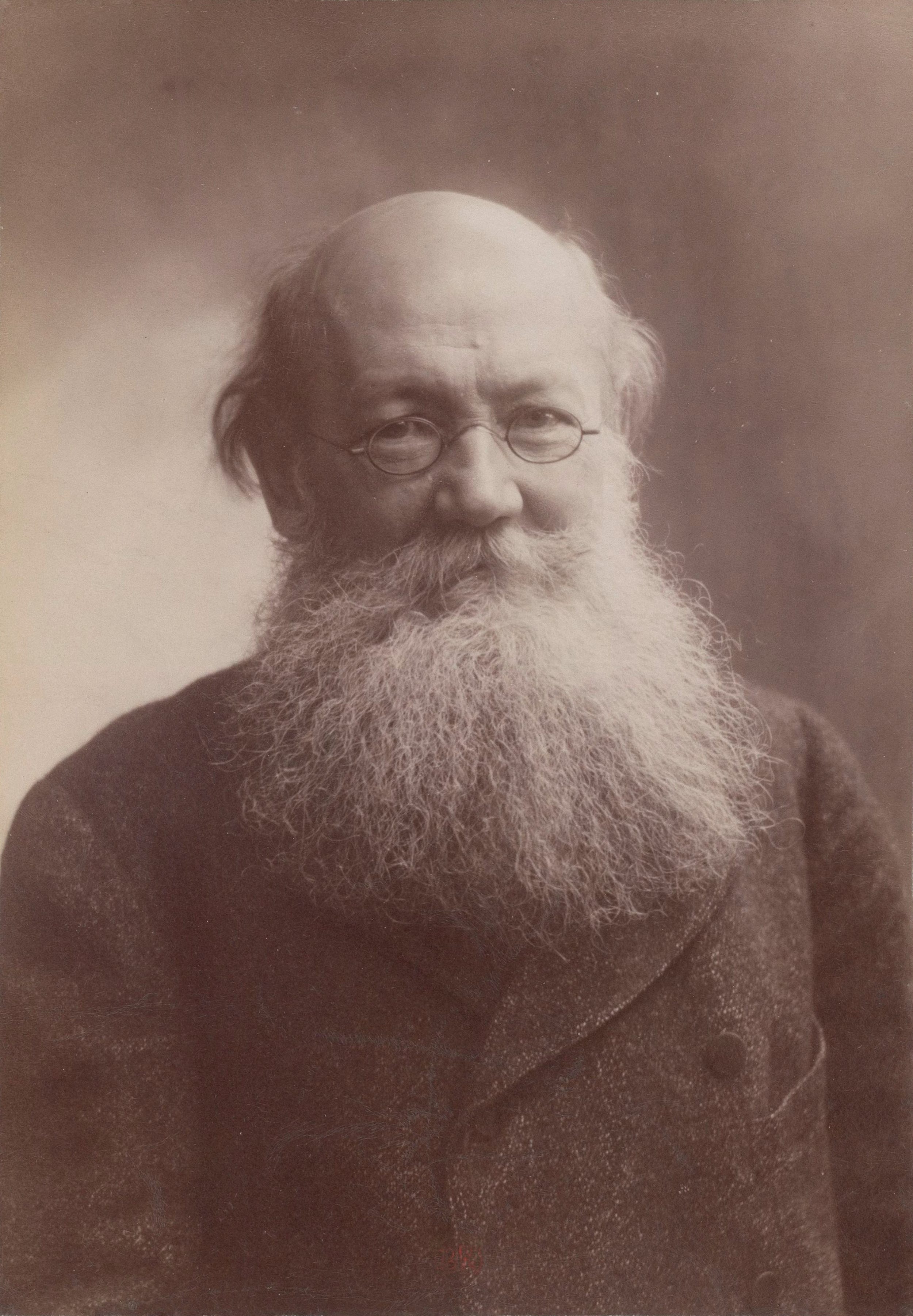
Affective Socialization Theory identifies that Peter Kropotkin correctly recognized Collective Agency Expectancy as a necessary part of our survival as a species; it is an evolutionary progress that has brought us to where we are now and has given us that tool to use. This tool expresses itself differently across the branches of evolution. Ants, for example, have a highly cooperative society based on a completely different architecture of pheromones and signals, whereas ours is based on neural state activation determined by our environment. In the early stages of human history, this was affected by the natural world and its different environments, both dangerous and safe. This taught us that in safe spaces, we could connect and engage in creative projects together to plan, invent, and work cooperatively. Since we constructed a second environment, a social environment on top of the natural one, we created the base and the superstructure that Marx outlines. This affects our nervous systems in a recursive feedback loop largely dictated by the cultural hegemony introduced by Gramsci; AST gives mathematical formulas to interpret this with variables that go from the individual and aggregate to become macro-level variables. These, in turn, go back down and influence those individual variables, which represent the individual neural baselines of all the people within that social context, whether it be a country, a community, or even a smaller group.
While the Marxist-Leninist revolutionaries of the twentieth century did prove the scientific validity and reproducibility of the vanguard and democratic centralism to organize a movement for decisive action, replacing the old state and constructing a new one based on socialist ideology, they lacked the hard understanding of neuroscience that we now have in the twenty-first century. This science shows that relying entirely on survival-panic logic will inevitably destroy the cooperative capacity of the very society you are trying to build. Relying on the ideological purity of the intellectual members of the vanguard is an error that Lenin, Stalin, and many other revolutionaries did not have the ability to know. It would be impossible for them to consider that their sympathetic nervous system was driving this hyper-vigilant pattern recognition out of a threat response, set up to be competitive and to dominate. Even though professionals collaborating on these plans can make very logical decisions, if the revolutionary authoritative state is not set up correctly, cozy intellectuals living a privileged life can easily form a breeding ground for opportunists. These opportunists still carried capitalist or feudal culture programmed into them before the founding of the new socialist state; they relied on the sympathetic nervous system threat response to defeat the revolution ideologically. You take those people who are locked into a competitive, threat-response reactive state, give them a cushy apartment, and let them live a privileged life separate from the real struggles of the population; it is easy to see how this environment will decay from its original purpose. If this explanation is not convincing enough, we only have to look at the fact that the party saw this pattern of opportunism and reacted several times to purge it.
As a Marxist-Leninist, I know even the CIA admitted that Stalin was not the dictator they portrayed him to be; official FBI reports stated he was more like a captain of a football team, and that Khrushchev would be the new captain. This was spoken about upon the time of Stalin’s death. I have always completely rejected the liberal framing of Stalin as an evil boogeyman, and I have definitely always resented Khrushchev for portraying everything as Stalin’s fault. If we use Affective Socialization Theory, we can see that not only was Stalin a product of his time, which would be the standard apologia excuse, he was also humbly and righteously motivated by a very real desire to be a great revolutionary who took part in changing the world for the better. He and the other members of the intelligentsia could not realize that their necessary hyper-vigilance trained their brains in pattern recognition suited for always detecting threats and dominating the enemy. Even though it was a historical necessity, this continued dependence on the Yellow Zone to construct theories and improve society once the socialist state had been won deeply affected the organizational culture of the apparatus itself, and therefore also affected the masses. This paranoid, hyper-vigilant culture was a very reasonable reaction. Fourteen countries invaded during the civil war after World War I to stop the socialist state from existing and defying capitalist rule. They understood the necessity of hyper-vigilant pattern recognition using the correct internal framing context of dialectical materialism. They correctly pointed out its necessity, yet it was impossible for them to know that this state blocks the Green Zone, which is the cooperative, higher social learning state they were seeking to foster. That is not to say that Green Zone microclimates and spaces enabling Collective Agency Expectancy did not exist in the Soviet Union; they definitely did, which is why AST classifies it as an authoritative socialist state. The party intelligentsia continued to operate on this hyper-vigilant pattern recognition, however, and as we know, many purges happened under Stalin, who kept seeing threats. The Soviet Union did foster a paranoid culture from that time, not as an inherent property, rather as a collective reaction to strong opposition from the capitalist world.
This is traditionally explained through the concept of siege socialism, which basically says that the failings under socialist governments were not inherent properties of socialism, rather they were the effects of socialism under military and economic siege by capitalists. With AST, we can more concretely see why. We can understand that even if there was no capitalist threat, if these professional revolutionaries developed a hyper-vigilant pattern recognition system in their brains without also cultivating the Green Zone as part of their neural baseline, the vanguard will quickly breed the same opportunism they are trying to destroy by being so hyper-vigilant about ideological purity once given the power of the state.
The Repressed Drive and the Fascist Trap
The understanding of the nervous system’s capture by the Yellow Zone, which keeps training systems of protection from threats, can be used to explain the broader trend of opportunism, especially among those who are part of revolutionary movements.
The Neurobiological Roots of the Savior Complex
The drive to secure a better future for humanity, which fuels this hyper-vigilance pattern recognition, can also construct a dissociation Hegemonic Mood Climate (HMC) that is unique to the individual; they develop what we traditionally call the savior complex. At this point, the neural pathways of self-preservation driven by this hyper-vigilant threat detection have enabled a high capacity of understanding. This may even be demonstrated in the success of the individual’s actions; actually coming up with a theory that moves people and spurs them into action becomes a powerful catalyst. Seeing your work make people move can very easily lead to a false perception that putting yourself and your preservation above this noble task is justified. You convince yourself that doing whatever is best for your individual body is what is best for the rest of the collective.
This savior complex is developed by the sheer awe of seeing that hyper-vigilant pattern recognition pay off and affect the real world. When one is disconnected from the broader revolutionary movement, this is even easier to fall into. It is especially true when one is not connected to marginalized and oppressed groups and is not inside building Green Zones of solidarity. When this happens, it is much easier to operate with an internal context framing that is convinced it needs to suppress the Green Zone and be ruthless in the quest to see the material world change by the power of that pattern recognition.
Combine that biological state with the security that the Imperial Cushion provides to the masses of the imperial core, especially white male citizens, and you get a chauvinistic, nationalistic movement. This movement seeks to opportunistically use old symbols of power to trail behind the masses, as Lenin would say, and warp that around to claim it is socialism. What I am talking about here is the patriotic socialists and the American Communist Party.
A lot of people can be outright disgusted and horrified that these groups display very toxic behavior toward each other, the marginalized, and the actual socialist and communist parties that exist. This echoes an earlier movement, the LaRouche movement, which used the language and symbolism of socialism yet spent most of its time physically attacking other socialist groups in the US. They believed their mission was to crush the competition, achieve dominance, and become the vanguard of the masses. It is very easy to see from just these two movements how this threat-based, hyper-vigilant pattern recognition operates when not kept in check with any Green Zone.
You have a toxic masculinity culture that people like Haz and other men were already a part of or influenced by through the manosphere. You already have that toxic masculinity that seeks to convince the masses of working-class men to stay in the sympathetic nervous system state all the time. It tells them they must always remain vigilant, never let their guard down even for a second, and suppress all emotions. That is literally capitalist culture trying to force working-class men into the Yellow Zone and the Red Zone of the dorsal vagal shutdown state; it directly socializes them into abandoning their highest, most recent evolutionary hardware, which gives them the ability for higher social learning, cooperation, and communication necessary for our survival.
From Individual Salvation to Collective Neuro-Capture
Take this mindset and internal context framing, then give it to someone who is religious. Many people have noticed there are a lot of these patriotic socialists who are religious. I am partially religious and mostly spiritual myself, however, that is beside the point. The issue is not the fact that they are religious in itself; it is the fact that they use religion to give excuses for Christian white nationalism and evangelicalism, which form the bedrock of the modern settler-colonial state of the United States.
When you are religious, I can tell you from personal experience, you can fall into this trap. I experienced this while going down into the depths of convincing myself to be ruthless and trying to actually become a sociopath, thinking that would give me success in my early adulthood. I told myself that God wants me to be good. Even though I was being ruthless, if the end goal was something good and it was all to help the rest of humanity, I could excuse any of my actions. The preservation of my body and my success was most important since I was the one who had this great hyper-vigilant pattern recognition. This felt like either divine insight during times of severe dissociation or just the acknowledgment that I am smart and have the potential to be the leader who fixes things.
I have direct experience with this feeling. I convinced myself that, despite my selfish ambitions, I would karmically still receive a great place in heaven or the afterlife. This deeply affects the internal context of some people. Even if it is not for that specific religious fear of the afterlife, there are a number of reasons people do this. This particular reason makes sense, as it is based on the fear of death and the uncertainty after death. Faced with the great, constant uncertainty of capitalism in life, it is natural that many of us will also fear what is next while fearing what is now. We may take refuge in religion or spirituality and find strength in it, as I also do. That fear of uncertainty after death, however, can create a mental justification that the individual is more important than the collective goals they claim to be trying to achieve.
The Affective Conductor in Power
As the article has thus far shown, the professional revolutionary theorist faces a dialectical biological struggle within themselves. They are using hyper-vigilant pattern recognition, which is a Yellow Zone threat-based survival state, to map out and construct how to defeat the oppressive apparatus inhibiting the cultivation of Green Zone social environments; they are also using it to reorganize society in a way that fixes these problems. They are doing so from the very same survival-based recognition and planning of the Yellow Zone most of the time, especially since they had no way to be aware of the dialectic itself. The happiness or mental health of revolutionaries was not always seen as important as we view it today, in the sense that it was believed that sheer ideological purity and will is what made the best and most principled revolutionaries. This understanding was based on the fact that there was no science to identify the real biological causes that motivate the organism. An explanation had to derive out of what the organism had to work with; thus, we Marxist-Leninist organisms have convinced ourselves that this threat-based pattern recognition, alongside the ability to construct networks and organizations that can respond to and defeat threats, is at times the revolution itself. I think this is most particularly evident in another historical figure for whom I have deep respect: Mao Zedong.
The interesting thing about Mao is that he was very committed to understanding this problem the article talks about and fixing it, yet he still sought to fix it through ideological purity and will. He believed he could use the threat-based pattern recognition he had developed to such a high degree that his words literally moved the masses. With that supreme confidence, he had no reason based on the current scientific understanding of the time to think this dialectical recognition and response system he had developed was actually not the best state to be in for the required empathy and Collective Agency Expectancy to be enabled in the environment directly after the revolutionary authoritative state is set up.
I am not saying that Mao was wrong about the continuous dialectical struggle that never ends even after the revolution; I will say that he misunderstood the complexity of all the dialectics involved, simply since there was no way he could know about the neuroscience that had not been developed yet. Basically, Mao saw this threat-based pattern recognition as the primary dialectic in the movement. Sharing this context with others and creating a collective internal context framing based on using these threat-based pattern recognition systems was believed to be what would create the class consciousness that Marx talked about to fully enable a revolution that creates true Collective Agency Expectancy and is able to surmount all obstacles. For the information they had at the time, this does make sense, and it may have even been historically necessary. Understanding the fact that Mao could not know the neuroscience in his time, his actions do paint the picture of someone who was trying to address these problems objectively and do what he believed was the best for the people and the masses. Due to this lack of understanding that modern neuroscience gives us, he could not understand the fundamental error of his ignition of the Cultural Revolution.
When the professional vanguard revolutionaries successfully used the survival threat-based response of the hyper-vigilant pattern recognition to successfully fight back against oppression, neutralize the agents of oppression, and construct the socialist authoritative state of China, they had achieved the first part. They were already on an inevitable path to make certain errors. This survival response in both the Soviet Union and China caused a massive push for rapid industrialization. This rapid industrialization would not be necessary if there was not the threat of capitalist imperialist nations waiting to use their military and economic power to destroy the socialist state and reinstitute capitalism in these countries. This is why we see the critique of siege socialism is also correct on this point. Who knows what the different outcome would have been if there wasn’t this necessary push for rapid industrialization to defend the socialist state, especially regarding the professional revolutionary intelligentsia class having that threat-based pattern recognition as their weapon to not only wage the revolution and seize the state, rather also to govern it afterwards. I am not going to go that deep into it here.
The point is that this push for rapid industrialization creates what AST theorizes as a maximum amount of objective Material Strain. All the survival categories of the MAT discussed and outlined in the other article discussing authoritative versus authoritarian states are checked off; this gives them an objective material strain score of 14, since the threshold is 15 in the current theoretical conceptualization of these interacting variables. What that means is that it is entirely dependent upon the subjective element: how the internal context framing shapes the material strain, and how much that internal context is contributing to the nervous state fixating on it and therefore being inhibited by it. What this means is that socialist rapid industrialization is a very real phenomenon which is not a totalitarian imposition from above; it is a true Collective Agency Expectancy in progress that is a powerful, empowering collective moment for all the citizens of the nation. The AST math also outlines that eventually this high objective Material Strain, even though there is no subjective material strain due to the empowering message and seeing that your work actually makes a difference for future generations that capitalism does not offer, produces a Mood Stability Index crash. This crash occurs due to the fundamental contradiction between the material circumstances and the subjective opinion of it. While this rapid industrialization of having everybody work hard all day every day by their own free will can produce tremendous results, it is not sustainable in the way it was practiced in the 20th-century movements. While labor can be reeducating and empowering, strictly subjecting the body to labor for many years, no matter how empowering it is, eventually cannot last. People need to rest culturally; they need to engage in leisure activities and have these Green Zone microclimates of safety, connection, and cooperation with others, not just a shared trauma of material strain.
Mao's Materialist Insight and Dialectical Limitation
Mao correctly identified the intelligentsia becoming a bureaucratic apparatus disconnected from the masses in the developing authoritative socialist state of China, as this was a core contradiction in Marxism-Leninism that he was already paying attention to and trying to figure out. Whether he saw himself as part of that bureaucracy or as somebody who contributed to its creation, his solution was telling the masses to bombard the headquarters and rebel against any corrupt party officials, stating that rebellion against the state was their right. By doing this, he made a real effort to use his power as an Affective Conductor to give power to the masses, which is in line with his ideological position and claimed goals. The key point, however, is that this tactic to try to remove the bureaucracy and force a collective AE environment utilizing the fight-or-flight sympathetic nervous system response was a dialectical error. If the socialist state is already set up to find ideological purity and let that rise through the ranks, why would the answer just be to remove the intelligentsia who are at the top of the party and part of this united social organism being developed? If this is a historical problem that Mao correctly identified in the USSR under Stalin, and he wrote extensively about how to ideologically combat this opportunism trend, it seems like a solution should actually look at why people in trusted democratic socialist leadership roles become opportunists. Instead of confronting this contradiction and doing more investigation, which he may not have felt necessary since the neuroscience did not exist, his neural architecture arrived at a conclusion that a new struggle had to be waged against this new bureaucratic class that he himself helped create. Not only his extensive writing on how to ideologically solve this problem, rather also his actions of directly telling the citizens of China they had a right to rebel against the government, is what started the separate ideology of Maoism. People around the world understood the contradiction of this new intelligentsia class, recognizing the big danger of opportunism once the Marxist-Leninist vanguard seizes the state. Seeing Mao’s seemingly enabling response telling people they had the right to rebel seems to have created this new ideology of Maoism, as it gives a proposed dialectical answer to the problem based in the same threat-based pattern recognition. It would make sense to people using that pattern recognition that this solution be a continuous struggle that never ends. Once you get into that intense dialectical thinking, you have to find an answer. That built-up confidence in the power of hyper-vigilant threat detection makes it hard to accept that there isn’t a material or scientific answer, and we already know with modern neuroscience that our brain will always try to fill in the gap.
This is where Mao actually ventured into idealism and took actions based not on dialectical materialism, rather on the broader field of dialectics. What this means is that he was making real dialectical observations: the observation that this new intelligentsia class creates opportunists, and thus those opportunists must be struggled against by the working class, creating a continuous dialectical struggle that is hard to see an end to. That answer is grounded in dialectical relationships, showing the back and forth, yet it is not grounded in material reality, which is the second most crucial part of dialectical materialism in our attempt to be real empirical scientists as Marxist-Leninists.
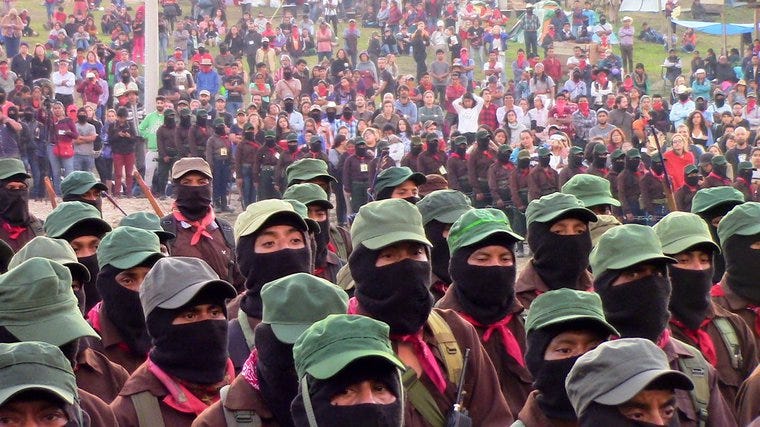
Using the understanding that AST gives us alongside modern neuroscience, we can say that Mao made a dialectical error, just like Mao said about Stalin. This shows he believed the understanding of dialectics itself could solve a material problem when the scientific solution of understanding neuroscience was not available as hard science yet. Many cultures have cultivated a wisdom for it for many years, especially Indigenous cultures like the Zapatistas in Mexico. They spent thousands of years cultivating a Collective Agency Expectancy and horizontal organizing, so when they had a revolution and claimed their autonomous territory from the Mexican state, they were able to actually transition into a non-hierarchical system of power where the leadership roles are rotated. They actually do not face the same problem that the Soviet Union and China faced. Some people might say it is due to a smaller scale, yet that is not the whole truth; the fact is that for thousands of years they trained a generational Collective Agency Expectancy that was much easier to go back to than the generational trauma of the neural baselines of the people of the Soviet Union and China, who for thousands of years built up Predatory Agency Expectancy and coercive Class Character of Context environments with pre-capitalist systems of hierarchical oppression.
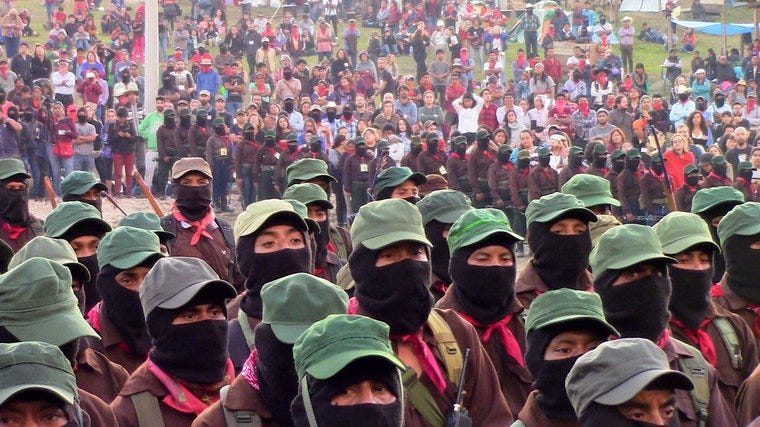
The hard science that AST proposes is even less necessary for Indigenous communities that have been practicing communism and organized socialism for thousands of years. For societies that have gone through many generations of Predatory Agency Expectancy, being trained in that way necessarily creates individuals who use hyper-vigilant threat-based pattern recognition. These people need the hard science in their fight-or-flight theoretical thinking. They do not necessarily have it culturally embedded the way certain Indigenous cultures do; they are trained on a completely different baseline. They are operating primarily from this Yellow Zone hyper-vigilant perspective that knows how to think dialectically and incorporate material facts to make it work. If the material facts are not there to give answers to the toughest questions, however, the brain will give an answer that makes perfect sense dialectically yet is wrong materially.
Uncoordinated Chaos and the Limits of Perpetual Fight-or-Flight
This is where we fully understand the action of Mao Zedong saying bombard the headquarters and telling the masses they have a right to rebel. Even some right-wing historians say it does not make sense for an authoritarian leader to tell people to rebel, noting it more reflects an anarchist ideology, while others just say it was a 5D chess move to manipulate the population to preserve his power. I think it is very evident that he truly believed he was resolving a dialectical contradiction materially by telling the people to bombard the headquarters. At that point, he also forsook his earlier sworn understanding that there is a difference between contradictions among the people and among the enemy. The intelligentsia class, who were professional revolutionaries that fought for the freedom for this socialist project to exist, are part of the people. If the new socialist society failed to implement measures to stop one of these people from abusing power and created this culture of abusive power, the issue is structural and does not call for violence. Revolutionary self-defense is fine, yet the uncoordinated, chaotic result of Mao’s instructions to the populations who so admired him as an Affective Conductor created a big spike in Hegemonic Volatility. He was able to use that to misdirect the responsibility for any of the problems off of himself to solve these dialectical contradictions.
When Mao was operating in the Yellow Zone hyper-vigilant pattern recognition, he constructed a plan for the survival of the socialist project itself. Putting that plan out to the masses as the Affective Conductor ended up creating a massive spike in Hegemonic Volatility. This unorganized mandate to rebel created a Hegemonic Volatility that would be similar to the breakdown of a capitalist state, even though it has its differences; it creates that revolutionary environment where a power vacuum opens up, and all of these different factions come up trying to either take advantage of it or repair it. This volatility pushed people into organized and even high-end expressions of both the Green Zone and the Yellow Zone. People who were already primed for conflict reacted exactly how you would expect. When you give people in certain villages or towns that have existing rivalries a reason to create an "us versus them" dynamic, it justifies their dislike of that person personally; if they have a personal grievance with them, this top-down authorization means they can finally act on it. Some groups organized genuine Green Zone mutual aid to survive the instability, while others locked entirely into Yellow Zone factionalism, using the ideological mandate simply to act on those existing rivalries.
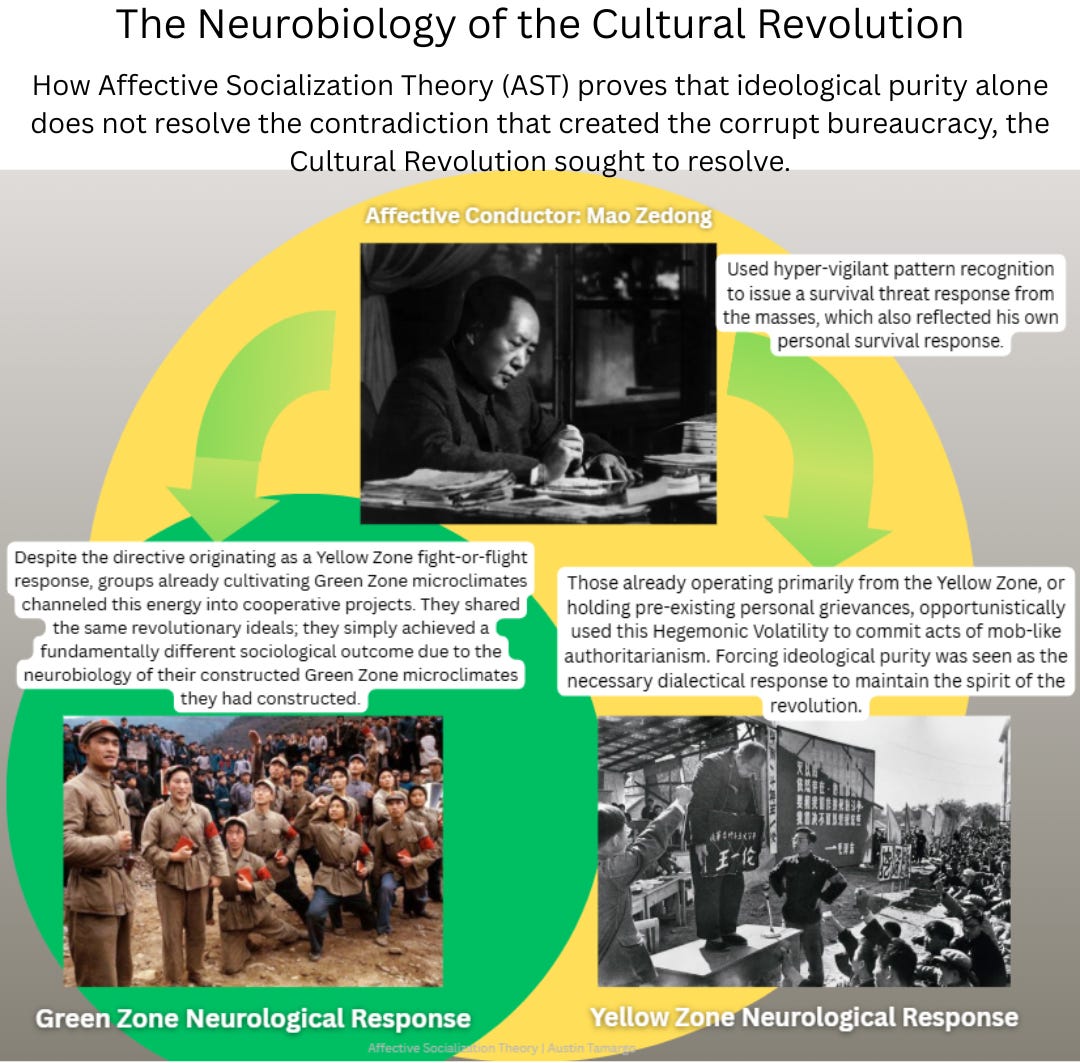
Before any Maoists, Marxist-Leninists, or anybody else who is a fan of Mao like myself gets defensive and wants to write me off, I 100% do not believe he did this consciously. I really believe there are times where a dialectical materialist theorist can guess about the nature of a material thing and be scientifically wrong about certain facts simply since there isn’t enough science available. When he was saying bombard the headquarters, I truly believe it made perfect sense to him as the answer to the dialectical contradiction, and he did not know it was in opposition to the actual material reality of the neurobiology.
Writing the Biological Code for Liberation
The historical contradiction of traditional Marxist-Leninist states is that you cannot force a population into the Green Zone using the hyper-vigilant, threat-based neural state of the Yellow Zone or the sympathetic nervous system. If a movement relies on a single Affective Conductor, or even a group of Affective Conductors who act as the professional revolutionaries and intelligentsia at the top of the party making and proposing plans, the Marxist-Leninist socialist state will continue to fail if the effect of that leadership on their nervous systems is not counteracted by hard empirical safeguards. These safeguards must not allow them to enforce these ideals of hyper-vigilance on the rest of the population trying to achieve Green Zone liberation. This is exactly why Affective Socialization Theory demands a structural cure. We cannot rely on the “ideological goodwill” of the vanguard, the “ideological purity” of the movement, or even the “principled nature” of its members.
There must be structural, implemented methods not only for the maintenance of professional revolutionaries’ connection to the Green Zone alongside the Yellow Zone; there should also be mandatory mental health protocols. Furthermore, there must be mandatory training away from the toxic masculinity which suppresses the Green Zone and can create this savior complex. We need systems of horizontal hierarchy integrated within the vertical hierarchy of the authoritative socialist state. It is true there must be an intelligentsia at the top proposing and submitting plans; however, this must be accountable to a truly democratic representation of the masses who can vote on these plans.
There basically needs to be a complete rework of how we envision this authoritative socialist state if it is going to be sustainable and viable for future projects. Currently, it has proven its use and effectiveness at building a revolutionary movement and taking control of the state, yet it has shown that it is not sustainable with the current conditions of the ever-changing social environment of our planet. It has been shown biologically why this has been unsustainable; even though the world is changing, there is a neurological basis that needs to be paid attention to, regardless of capitalism’s power to force siege socialism.
Ensuring the social body finally achieves true Collective Agency Expectancy and social liberation from the toxic systems of power that keep us in the Yellow and Red Zones requires rewriting the biological code of our movements.
In next week’s article, I will go in depth on a proposal I have for this, and about two weeks after that I will put out an article showing you how local community organizations are already intuitively recognizing this organizational necessity. So if you are not subscribed already please consider becoming a free subscriber to support my work and get the latest articles using the AST analysis.
References
Baumrind, D. (1966). Effects of authoritative parental control on child behavior. Child Development, 37(4), 887-907. https://doi.org/10.2307/1126611
Engels, F. (1958). On the history of early Christianity. In K. Marx & F. Engels, On Religion (pp. 312-343). Foreign Languages Publishing House. (Original work published 1894)
Gorky, M. (1924). Days with Lenin. International Publishers.
Kropotkin, P. (1902). Mutual aid: A factor of evolution. William Heinemann.
Marx, K., & Engels, F. (1969). The communist manifesto. Progress Publishers. (Original work published 1848)
Tamargo, A. (2026). Affective Socialization Theory: A unified model of behavior (Part 1: Neural wiring & the recursive system). Zenodo. https://doi.org/10.5281/zenodo.18514658
Thony. (2026). Personal communication, April 2026.
Wow, that is very deep. A lot of material is covered in it and it opened my mind. This article also helped me open my eyes to different connections I never thought of before. Thank you for taking the time to write this.