


In Affective Socialization Theory (AST), there is a heavy focus on diagnosing the disease, analyzing how the coercive architecture of capitalism physically wires our nervous systems for anxiety, predation, and burnout. But a diagnostic framework is useless if it cannot point to a cure.
Before we can fully operationalize the math of how to dismantle the capitalist macro-environment, we have to define exactly what we are building to replace it. We have to define socialism. Not as a utopian buzzword, but as a concrete, structural alternative. To do that, we must trace its origins, strip away the propaganda, and look at the empirical history of the concept.
In this specific series, which is adapted from my earlier book, the focus is strictly on the modern political movement that emerged in 19th-century Europe and spread around the world. It is a Eurocentric history because it traces the direct reaction to European industrial capitalism. However, since I wrote this book, I have continued research and have come to a deeper understanding: that while the political ideology of socialism is recent, the biological drive for human cooperation is ancient and universal. Long before Europe industrialized, indigenous societies across the globe successfully organized themselves around the same principles of creating cooperative, communal social systems. In future articles, I will go deeper into the differences in neuro-architecture between indigenous peoples, European colonizers, and other societies, but to understand how to dismantle the modern capitalist state, we first have to understand the specific material trauma that birthed the political movement to destroy it.
Introduction
“What he’s proposing is socialism!” Honestly, can you remember a time when you heard something like this said by a TV personality or politician? Or does it at least sound familiar to you, even if you don’t know why? If you’re someone in the United States like me, I think the chances are high you said yes. This is because socialism is a buzzword; it is used by a wide and varied range of people who all seem to shape it to their own definition, one that best suits whatever their personal agenda or motivation may be. Hold up, what does socialism actually mean?
People may have their own meanings for the same word, sure, but what is the real “definition,” then? That too, dear reader, is not something so straightforward. The concept of socialism has not only evolved or changed over time, it has also varied by place and by cultural context.
Broadly speaking, socialism is a political theory, philosophy, or ideology, and also an economic system of production. Since our overall welfare is generally determined by our economic reality, socialism attempts to realize the philosophical notion of making the world a better, or even ideal, place by transforming the economic reality, and therefore the material conditions, of the members of society as a whole.
In this series, we will first explore the origins of the term, the development of the theory, and the various ideological perspectives that have arisen from that development (over time, in different places and cultures). Following that, we will look at the common principles found across these variants, compare the concept to related ideas that are often confused with it, and then conclude with a look at the content and outcomes of socialist policies and experiments.
The Origins of an Ideology
The word “socialism” is only about 200 years old. According to Cynthia Resor, a professor of social studies and published author on the subject, “The word socialism began to be used in the 1830s, to describe a system different from capitalism” (Resor). With the inventions of heavy machinery and the factory, the way people in Britain and France made their living, and thereby the way they lived their lives, was dramatically and suddenly changed. After only a few generations, life went from being rural farming for most people to populations concentrated in dense urban cities: black smoke billowing through the air, animal waste soaking the streets, many entire families living in one-room, badly constructed structures with no furniture, and pig pens beside these living structures in cities where the buildings (and these animal pens) were wall to wall (Engels, 1845).
In his book The Condition of the Working Class in England in 1844, Friedrich Engels gives a firsthand account of the living conditions he observed in different English cities; he also cites relevant data and research into the phenomenon, and anyone who reads this work will quickly see just how bad these living conditions were. It was because of this new economic reality, created by the emerging technology of heavy machinery, that production necessarily became more cooperative and organized: from many spread-out family farms all over the country, all paying taxes to their local lords, working whenever they needed to (usually only half a year), and with no demand to change or increase productivity (people generally made enough to support themselves, and there was not an economic or cultural reason to try to increase production), to then, in only a few decades, those same families having to vacate their land (when private property became law, and peasants’ right to live on and enjoy the fruit of the land they lived on was taken away) and move to densely populated, health-hazard-ridden cesspools that actually lowered overall life expectancy.
What does this have to do with socialism? The answer lies within this same concept of emergence: the desire for liberation from these horrid material conditions inspired a new social concept based on a desire that humans seem to have collectively had since time immemorial, the desire to create a better life, and the word for this new idea rooted in ancient human strivings was “socialism.”
First Theorists

Around the 1820s, Henri de Saint-Simon, known as one of the first socialist theorists, coined the term “social physiology” to describe his view of society as an organism, with different parts that we can study, understand, and help work together. The key point here is that he believed the scientific method could be applied to society; how it is applied, however, is what distinguishes him from later scientifically minded socialists. He did recognize that the working class should be recognized and happy, but thought that the main threat to this happiness was what he called the “idling class”; basically, he was saying that lazy people are the reason for society’s problems. Henri also believed that Europeans were a superior race and advocated for world colonization by Europeans.
While Henri was correct in his most famous point, that society, like an organism, can be looked at scientifically and manipulated toward an ideal, his social ideals were obviously a product of the racist and classist environment of the time and culture he came from, and acceptance of it, even the superimposing of it onto this new idea of scientifically analyzing and restructuring society. Henri is also recognized as one of the main founders of “Christian socialist” thought, and this is interesting when we compare his ideas to the ideas of modern-day white Christian nationalists in America. The ideas that lazy people abusing the system are making it harder for everyone else, and that it is the job of “civilized” white people to bring other cultures up to their standards and ideals, are both big topics of discussion among people who today say they are only being practical in proposing a scientific way of analyzing and dealing with society’s problems, and also that they are doing this out of some desire to make our society more ideal.
When Henri and his many followers in his school of thought first thought, basically, we want a more ideal society, this is the concept; now, how can we achieve it? Without any reference point of what a more ideal society looks like materially, Henri and other intellectuals defining this term in the early days looked within. What were their ideas of a better society? If you were growing up in the early 1800s in France or Britain, and you were like most people and accepted the mainstream ideas and opinions of the time, you might come to the conclusion that rounding up everyone who isn’t in a factory and putting them in one to maximize production, and then conquering the rest of the world in the name of God and your “superior” nation, would be the most efficient way to achieve this “more ideal society.”
In these early days of working out the ideas of what socialism meant, philosophers and scientists did not stop at thinking in their own heads what would be ideal; some of them experimented as well, putting their ideas to the test in the real world and learning from it. There were a number of people who decided to start their own self-contained communities, or communes, in which all of the members would agree beforehand to follow certain ideals and practices, which they believed, if they all followed, would create the ideal society. The most famous of these people is Robert Owen, a Welsh factory owner who, in 1824, spent most of his fortune to start one of these communities all the way across the pond in Indiana, US. After two years, his socialist experiment, like many other “utopian socialist” experiments, failed to maintain sustainability and fell apart.
In 1828, Robert Owen moved again to London, and, learning from his experience, he spent his time and energy on other methods of trying to create this more ideal society. He advocated in Great Britain for free education for children and better living conditions for people in factory towns, and even helped a project (one that ultimately failed) that tried to make wages more transparent and equal to time worked. As the years went by, the public consciousness, as well as Owen’s, of the word socialism and the concept it represented began to mature; it was going in a more scientific direction. Instead of enforcing ideals (from mind to matter), socialism began to mean, to a lot of people, addressing the material conditions of the working-class people (who were and are the majority of people in society) and seeing what direct actions can be taken to actually improve them. Owen’s writings are credited with popularizing the word “socialism,” and he also helped with the forming of some workers’ unions. He remained an advocate for the improving of the lives of working-class people until his death in 1858.
The Pivot to Marx and Engels
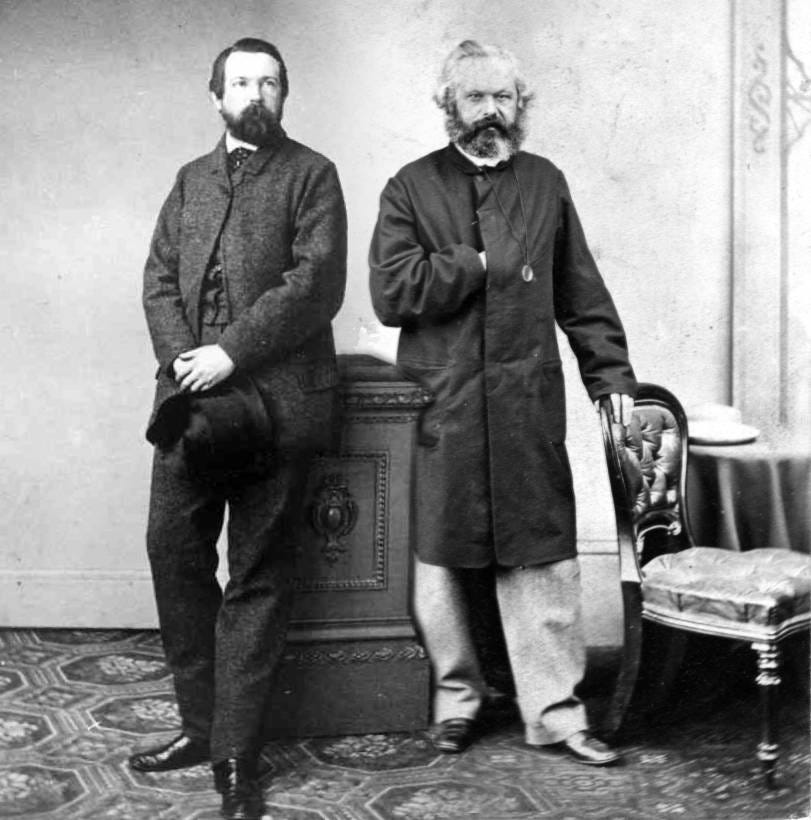
The views of people like Henri and Owen in these early days of socialism are described as being either utopian or reformist by the next early thinker on the subject, who is also known as the most influential socialist thinker in history, his name is Karl Marx. After getting his PhD in philosophy, Karl Marx worked as a writer, notably as a London-based correspondent for the New York Times. Marx was very interested in the philosopher Hegel’s concept of dialectics, which describes emergence as something that occurs from opposing forces conflicting with one another; by this, something new is created.
Marx was already a supporter and advocate for a better world, and was already good at analyzing problems in the world, but when he met Engels (the same one who wrote The Condition of the Working Class in England in 1844, which Marx read and liked) was when he began to develop the ideas he was most famous for. They would forge a friendship and intellectual partnership for the rest of their lives, working out ideas together and developing socialist theory. Marx and Engels would write many books together, both being listed as two equal authors; they also participated in unionizing and organizing the working class, and even participated in revolutionary struggle to help overthrow oppressive governments.
A Note on Authorship Also, because Marx and Engels were two great thinkers who collaborated on many key texts of Marxist theory, which is, in modern-day, most often just attributed to Marx without recognition of Engels, I will sometimes say “Marx said…” (excluding Engels) when I talk about Marxist theory; if I am referencing Engels’ specific contribution or a text he is the sole author of, I will just mention Engels. So, if I say Marx, then most often what I mean is Marx and Engels; it is a shorthand for their collaborative partnership.
Coming Up in Part 2: In the next installment of this series, we will dive deeper into the development of Marxist theory, exploring exactly how Marx and Engels constructed the scientific framework to dismantle the capitalist machine, and how that theory fractured into the different socialist movements we see today.
This article is a serialized, adapted excerpt from my book, What is Socialism? A Concise Analysis to Clarify the Concept. If you prefer to read the entire book at once, or want to support this publication, you can [grab the physical paperback on Amazon here].
References
Engels, F. (1880). Socialism: Utopian and Scientific. Marxists Internet Archive. https://www.marxists.org/archive/marx/works/1880/soc-utop/index.htm
Engels, F. (n.d.). The condition of the working class in England. Marxists Internet Archive. https://www.marxists.org/archive/marx/works/download/pdf/condition-working-class-england.pdf (Original work published 1845)