

Author’s note: In Affective Socialization Theory (AST), there is a heavy focus on diagnosing the disease, analyzing how the coercive architecture of capitalism physically wires our nervous systems for anxiety, predation, and burnout. But a diagnostic framework is useless if it cannot point to a cure. Before we can fully operationalize the math of how to dismantle the capitalist macro-environment, we have to define exactly what we are building to replace it. We have to define socialism. Not as a utopian buzzword, but as a concrete, structural alternative. To do that, we must trace its origins, strip away the propaganda, and look at the empirical history of the concept.
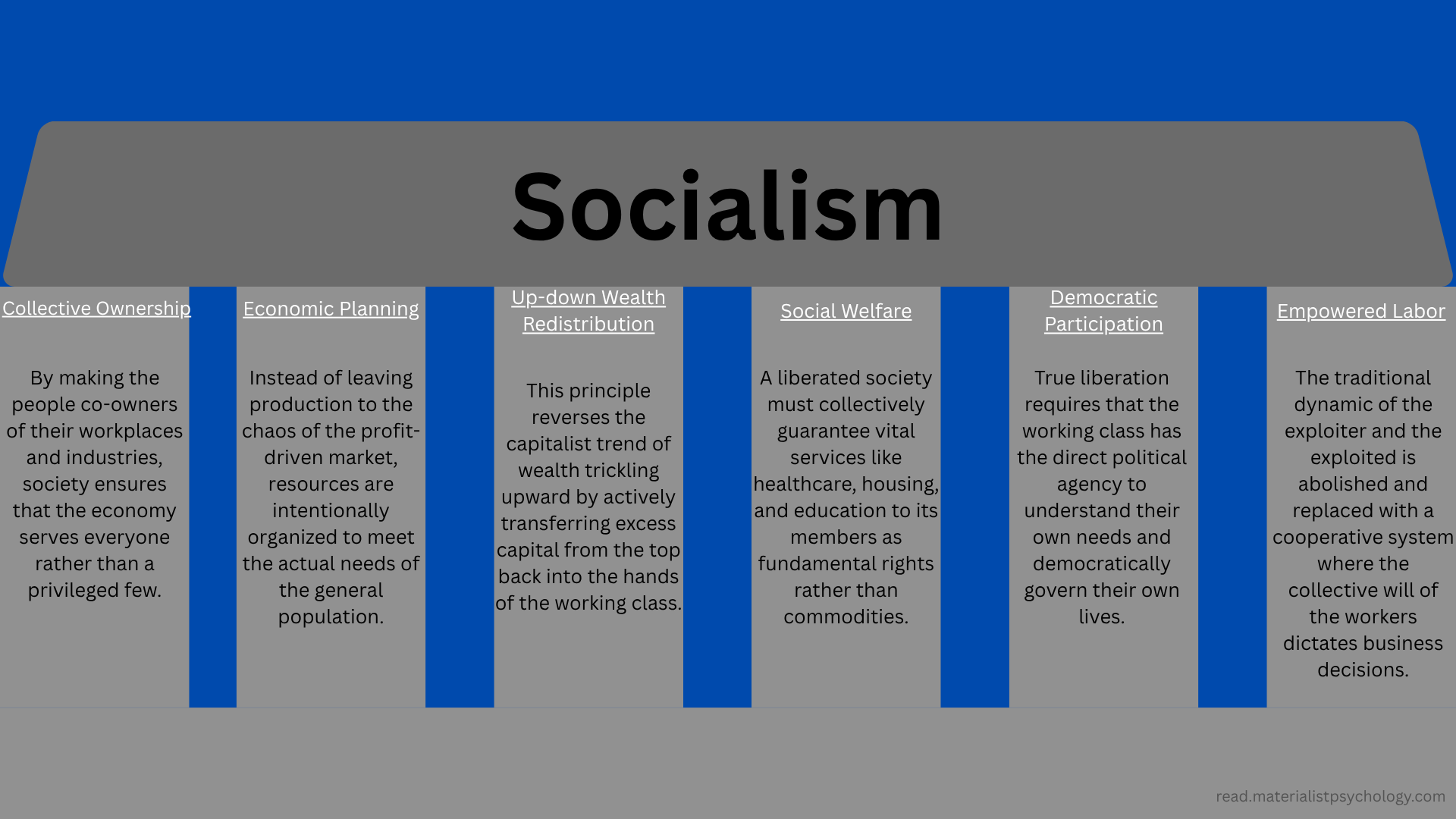
In Parts 1-3, we traced the origins of the word socialism, explored how Karl Marx and Friedrich Engels developed it from a utopian ideal into a materialist science, and mapped out the complex ideological branches that grew from those foundations. Now that we have identified the differences between movements like Marxism-Leninism, Democratic Socialism, and Anarchism, we can synthesize our analysis. In this section, we will strip away the specific factions and look at the six fundamental core values that unite all forms of socialist thought.
Collective ownership of the means of production means that the people as a whole all become co-owners of the industries in their society (being able to democratically decide how they are run) and of the workplaces they work in. Although in Social Democracy the ownership of the means of production is still in the hands of private individuals, those individuals are taxed, and so it is argued sometimes that, in this way, the citizens are democratically participating in decisions of allocation of where certain profit created goes; and so, in this way, a small form of collective ownership is present, although this idea is heavily argued against by other forms of socialist thought.
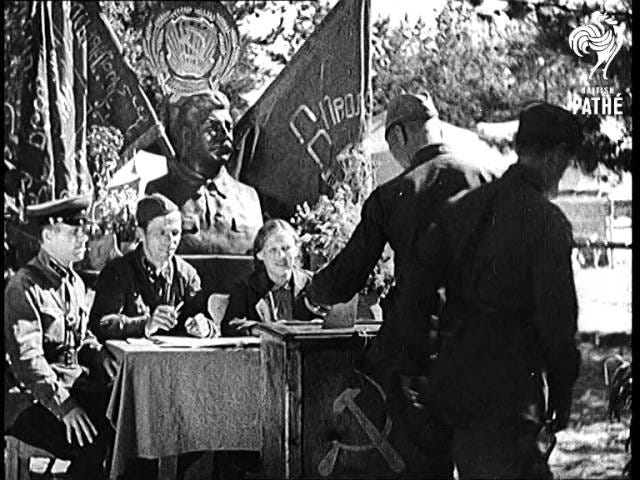
Economic planning is a key concept that, as the interview with Stalin in the last chapter shows, has been understood by some people to be a core idea of socialism. Wells, the interviewer, attempts to show the similarities of American Social Democracy with the USSR’s Marxist-Leninist socialism by explaining how they are both organizing and planning production in ways that benefit the general population. This continues to be considered “the essence” of socialism in some people’s understanding of the word, but economic planning is not something only found in socialism. The economic planning of the USSR and China proved to the world what organizing production could do when directed at a certain goal. At the time both of these socialist states were beginning to do this, most capitalist governments did not try to control the direction of industry in the country, especially not to the extent that Marxism-Leninism did, and so the contrast of the two systems in their level of organized economic planning was often remarked on. However, especially with the concentration of capital into fewer hands, the trend of capitalism to form monopolies identified by Marx, the monopolized industries began to conduct their own economic planning, not toward the goal of socialism, but toward achieving the highest amount of profit for the shareholders, or individual owners, as possible. A great example of this is the planning that goes into running modern American corporations. Walmart, specifically, has every aspect of its business down to a thoroughly studied and developed science, and writings and video documentaries have been made about it.
Up-down wealth redistribution means enacting political policy (or, by other means) that expropriates wealth or resources from the people in society who have the most and transferring it into the hands of a broader population of poor or working-class people. The distinction of “up-down” is necessary in technical terms because wealth redistribution happens consistently under capitalism, but from the bottom up: capitalists continuously and increasingly, systematically transfer the wealth generated and held by the working class to themselves. This represents socialism’s commitment to improving the lives of working-class people.
Social welfare refers to the act of a society collectively providing vital and convenience services to its individual members. Examples of this include free or universal healthcare, free education, public transit systems, government investment in developing cheaper and better products like cars, subsidized housing or other resources, and many more. Details on the implementation of these policies will be discussed in the “socialism in practice” chapter.
Democratic participation is seen as a necessary element of socialism because, to better the quality of life of the working-class people, or even the broader society as a whole, the actual needs of the people need to be understood through their own participation, by them making decisions of their own accord, and their liberation is only truly their liberation when it comes from their own agency, not bestowed upon them by a ruling power, but self-declared and made law by their democratic vote. This core value shows the desire of socialism to bring more agency to the working class by empowering them to come to a consensus among themselves.
Labour relations, ideally, under socialism, completely transform from the exploiter/exploited system where an autocratic ruler (the capitalist) maintains the right to the final say on all business (and even sometimes industry-level) decisions, to a democratic process in which the collective will and welfare of all the workers are taken into account.
Coming Up in Part 5: In the next section, we will clarify exactly what socialism is not. We will break down the crucial distinctions and common misconceptions between socialism, communism, social democracy, liberalism, and fascism to cut through modern political propaganda.
This article is a serialized, adapted excerpt from my book, What is Socialism? A Concise Analysis to Clarify the Concept. If you prefer to read the entire framework at once, or want to support this publication, you can [grab the physical paperback on Amazon here].