

Author’s note: In Affective Socialization Theory (AST), there is a heavy focus on diagnosing the disease, analyzing how the coercive architecture of capitalism physically wires our nervous systems for anxiety, predation, and burnout. But a diagnostic framework is useless if it cannot point to a cure. Before we can fully operationalize the math of how to dismantle the capitalist macro-environment, we have to define exactly what we are building to replace it. We have to define socialism. Not as a utopian buzzword, but as a concrete, structural alternative. To do that, we must trace its origins, strip away the propaganda, and look at the empirical history of the concept.
In Part 1 of this series, we explored the early attempts to solve the crises of the Industrial Revolution through Utopian and Reformist currents of socialist thought.
Although Robert Owen is known as one of the early Utopian Socialists, after seeing the results of his experiments, he later became more of a reformist, seeking to change the system he was in so that it would be more fair, and advocating for legal reforms that would improve the lives of the working class. We see by this example that these two labels, Utopian and Reformist, represent not merely individual interpretations of the concept by different thinkers, but two currents within the concept that were taken into account and championed by different people at different times, and developed by the proponents of each current. Henri de Saint-Simon advocated for matters of state policy that could be legally implemented, which he believed would lead to a more ideal society. So in this sense, his ideas would be grouped with the “reformist” strain (or current) of socialist ideology, though admittedly very abstract and seemingly antithetical to later interpretations of the word.
The Engine of History: Dialectical Materialism
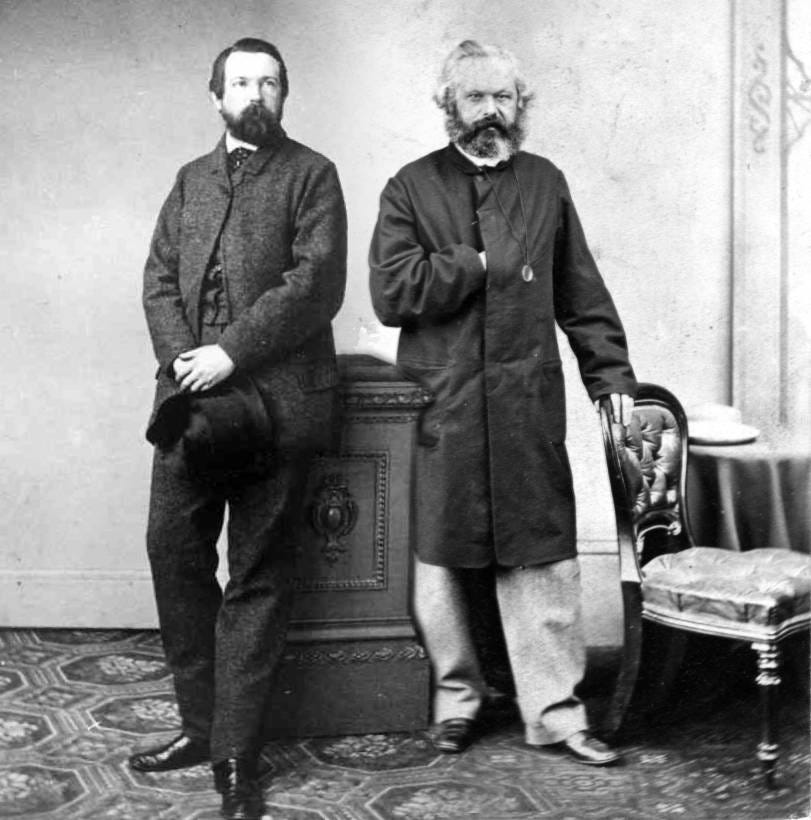
Marx came along and pointed out what he said were the flaws in both Utopian and Reformist socialist theory. It all started with his (and Engels’) theory of dialectical and historical materialism. As I said earlier, Marx was interested in Hegel’s philosophical concept of dialectics; Engels was also a fan of Hegel’s ideas when they met; however, the dialectics in Hegelian philosophy were spiritual and abstract, not grounded in empirical reality. For instance, Hegel believed the world progressed through the development of ideas or concepts, which, when they emerged, transformed society and brought about change. The way this emergence happens, according to Hegel, is the conflict of opposing ideas: the conflict itself, the struggling of these ideas to juxtapose one another, is what creates new ideas, and these new ideas bring about change. Change the perspective, change the reality, to put it simply.
Marx and Engels took this idea and turned it on its head. They said that it is not ideas that bring about change in the world, but the world (or society) that brings about change in ideas. When applied to society, this means that the changes we go through in our society, from small incremental changes like the gaining of rights to things as big as the change from monarchy to capitalist democracy, are all the result of a change in material conditions, which in turn change the ideas, the consciousness of the people, which then act upon those new ideas.
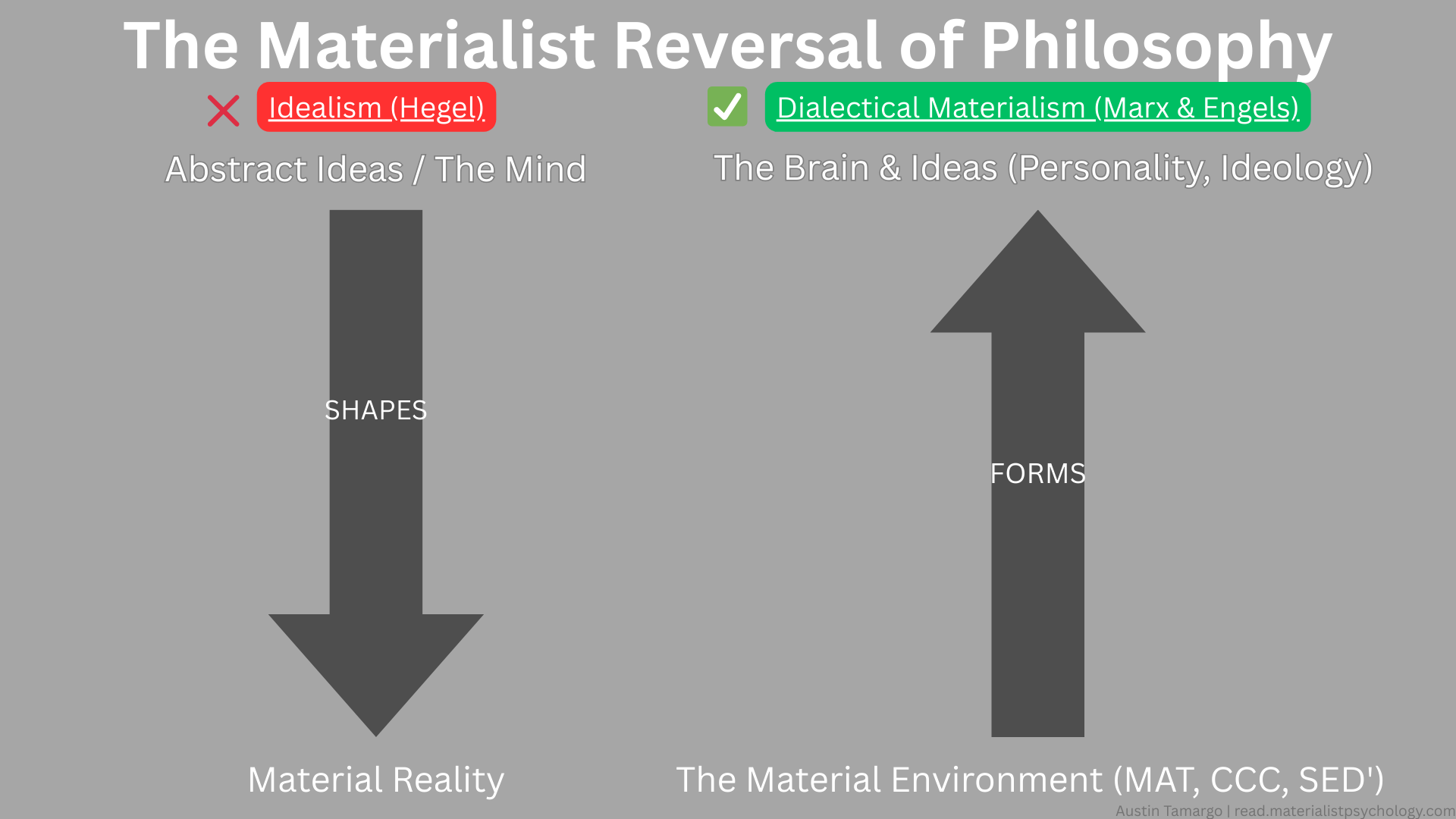
Marx’s outlook opposed the very popular idea in philosophy at the time (and in many civilizations throughout history) that the world we live in originates from ideas, the mind, or the spirit, and that this spirit guides ideas, which, when acted upon, change the material world. Along with this outlook, it is sometimes even implied or outright stated that the world originates from the spirit, an abstract thing that we cannot empirically observe or measure. To be truly scientific, Marx understood that we cannot start with abstract, empirically unobservable notions; we have to start with actually observing our material reality if we want to change our material world; then we can create the hypothesis. If we start with that first step of the scientific method, observation, we can easily observe that the brain, which creates our ideas, is material. It is part of the physical reality, and so our ideas come from matter; matter does not come from ideas; all ideas come from matter interacting with each other, and all matter exists regardless of ideas. Before humans, or even intelligent life in general, there is no evidence of ideas existing, but we do have evidence of matter existing long before humans or animals. We know that brain matter interacts with itself in a way that activates our thinking skills and allows us to have ideas. This is a simple point, but it is one that is hard to argue with on a scientific basis.
Class Struggle and Historical Materialism
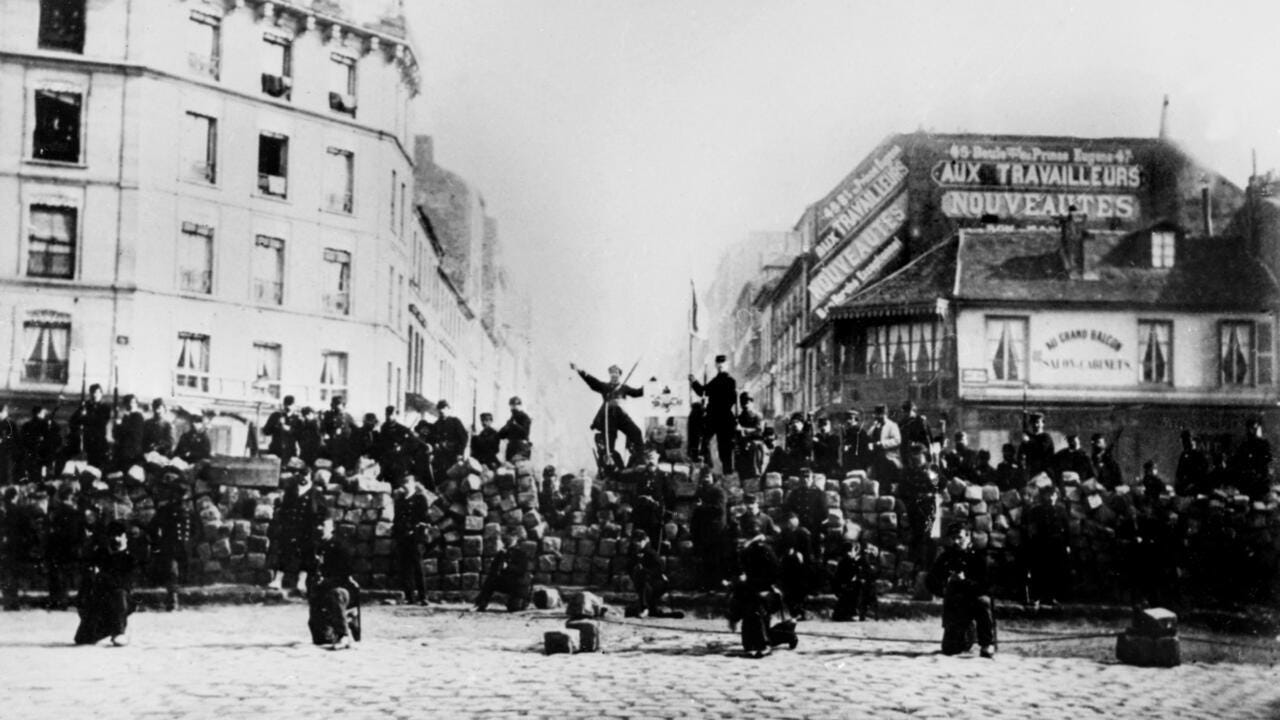
So this concept that our material reality is what shapes our ideas, and that the contradicting material forces in society are what give rise to the emergence of new ideas and ways of life, this is Dialectical Materialism. Taking this approach to analysis and applying it to the study of the history of society is what was then named Historical Materialism. Using historical materialism in their analysis, Marx and Engels discovered that the big transitions in history, when large groups of people (nations, cultures, peoples) fundamentally changed the way they lived their lives (like the government system, organization, and stratification of society), were always the result of the dialectics reflected in class struggle, and the new system that emerged (like from monarchy and feudalism to capitalist democracy) was the emergence that resulted from that struggle creating something new.
Class struggle was/is the struggle between the ruling class (those who hold power to dictate the organization of society) and the exploited class(es). Polish philosopher and historian Leszek Kolakowski remarks, “Utopian socialists imagined ideal cooperative societies, while Marx and Engels described theirs as ‘scientific socialism’ based on historical laws of development” (Kolakowski, 1978). This explanation from Kolakowski is concise and easy to understand, but this quote by Engels gives more context as to why these ideas developed when he says, “Its task was no longer to manufacture a system of society as perfect as possible, but to examine the historico-economic succession of events from which these classes and their antagonism had of necessity sprung, and to discover in the economic conditions thus created the means of ending the conflict” (Engels, 1880).
Socialism, to Marx and Engels, was not just trying to make a perfect society how you thought it should be, but a scientific attempt to observe how we got to where we are in society and what the contradicting social forces are that are currently operating on each other in society, and then, with that data, try to figure out how to set the conditions where these conflicts no longer exist. To do that, Marx believed that the overarching socioeconomic system (the government, the economic way of life that sets the basis of value which that government enforces, etc.) had to be overthrown by the working class, which would then abolish the right of one person to own the factory that many people work in and profit from, all their labor.
The Anatomy of Exploitation
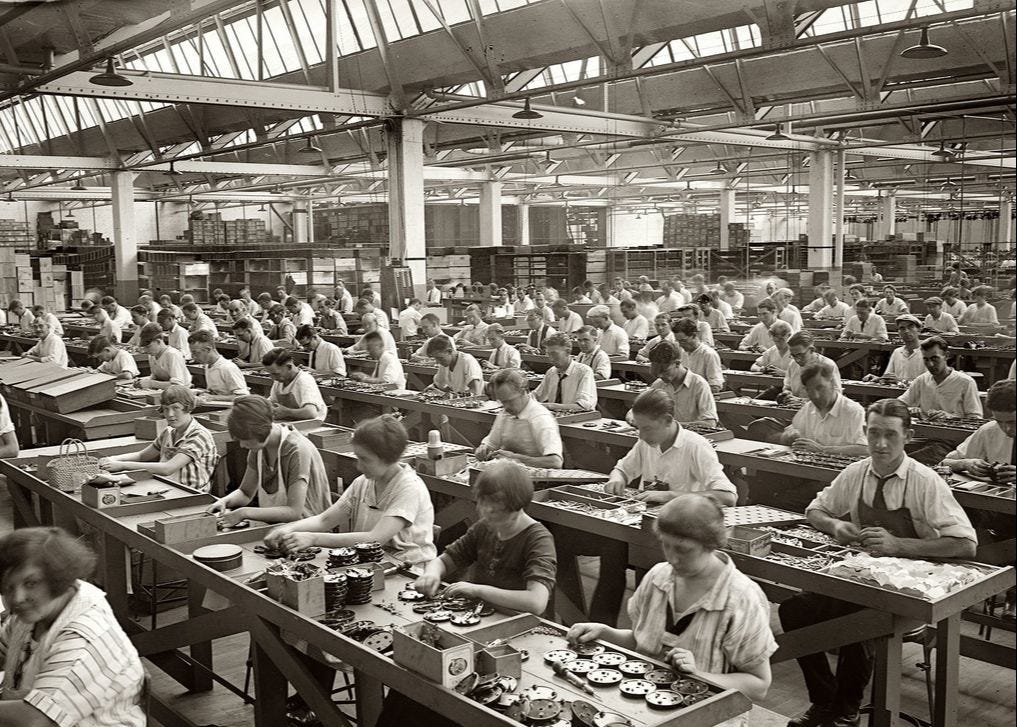
Marx believed the economic system of capitalism created a new class struggle between the proletariat (which was the industrial working class) and the bourgeoisie, or the capitalists who, usually by inheritance, owned the factories that the working class, who had no capital (no factories of their own from Daddy), had to use the only capital they had, their body; they had to sell themselves as cogs in the machine of those who won the birth lottery; or, in Marx’s own words:
“In handicrafts and manufacture, the workman makes use of a tool, in the factory, the machine makes use of him. There the movements of the instrument of labour proceed from him, here it is the movements of the machine that he must follow… In the factory we have a lifeless mechanism independent of the workman, who becomes its mere living appendage.”
(Marx, 1867)
Marx observed that while the new form of production in factories alienated the laborer from the fruits of it (separating the worker from the products of their labor, which does not belong to him but the capitalist, who claims it all for themselves and pays the worker as little as necessary to meet their needs so they can continue to live and work another day), it also made work much more social. Instead of scattered big family farms where you would work the land by yourself or with only close relatives, now workers met and interacted with their community every day. This social aspect of the new relations of economic production is contradicted by the fact that the outcomes of their collective effort are being siphoned off by one person at the top, who has also been given total authority over all decisions within the company, and whose labor is not required for the factory to keep running day to day.
For the capitalist, how much they make is directly linked to how little they can pay their workers, because, as Marx thoroughly points out in many of his works, the profit of the capitalist is extracted from the value that the laborer creates through their work. With unions of workers becoming a thing around this time as well, workers were beginning to understand that their well-being, determined by how much money and resources they had, was directly linked to how much they could get their employers to give up. This is the dialectics of class struggle. Marx believed that only by the workers dismantling the old socioeconomic system, which was built from its foundation, coded into its laws the domination of the ruling class over the rest of the populations, only by ending this system and creating a new one (which has happened at various times in history through revolutions) based on the rule of proletarian democracy (democratic rule of the working class) could the disparities of wealth, and the suffering they create, be systemically eliminated.
The Great Schism: Revolution vs. Reform
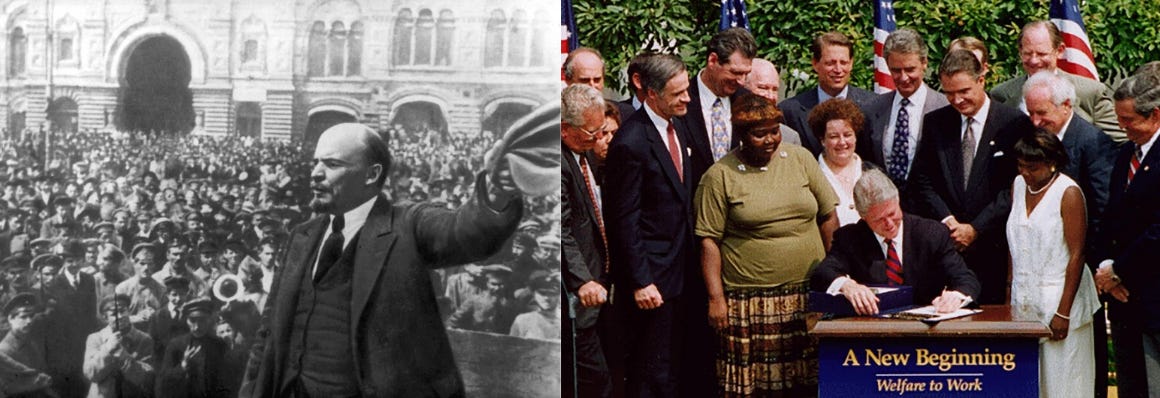
In the early 1900s the distinction between people who identified as communist (and socialist) and those who identified only as socialist, along with what that meant to those people, became more defined. There arose people, and then whole nations, that identified with the emerged concept of “Marxism-Leninism,” and these people and nations became also self-described communists, but also socialists, who saw themselves as living in a socialist country.
The ideological reasoning for this seemingly confusing identity will be explained in a later section, but the point here is that, in response to this, the terms “Democratic Socialism” and “Social Democracy” soon evolved meanings that both shared a distinction from Marxism-Leninism (and its parent ideology, Marxism). While Marxism advocated for the overthrow of bourgeois society and its institutions, its organizations of power, the state itself; in contrast, Democratic Socialism and Social Democracy became more and more associated with the concept of using existing democratic processes within the current system to gradually move toward socialism, or at least toward more ideal material conditions for the working class.
Coming Up in Part 3: In the next section, we will go into more detail on the different ideological perspectives that have now arisen out of this defined ideological split in interpretation of exactly what socialism is, clarifying what these movements are fighting to achieve today.
This article is a serialized, adapted excerpt from my book, What is Socialism? A Concise Analysis to Clarify the Concept. If you prefer to read the entire framework at once, or want to support this publication, you can [grab the physical paperback on Amazon here].
References
Engels, F. (1880). Socialism: Utopian and scientific. Marxists Internet Archive.
Kolakowski, L. (1978). Main Currents of Marxism: Its Rise, Growth, and Dissolution. Oxford University Press.
Marx, K. (1867). Capital: A Critique of Political Economy (Vol. 1). Marxists Internet Archive.