

Author’s note: In Affective Socialization Theory (AST), there is a heavy focus on diagnosing the disease, analyzing how the coercive architecture of capitalism physically wires our nervous systems for anxiety, predation, and burnout. But a diagnostic framework is useless if it cannot point to a cure. Before we can fully operationalize the math of how to dismantle the capitalist macro-environment, we have to define exactly what we are building to replace it. We have to define socialism. Not as a utopian buzzword, but as a concrete, structural alternative. To do that, we must trace its origins, strip away the propaganda, and look at the empirical history of the concept.
In Part 1-4 of this series, we looked at the historical origins of socialist theory and the word itself, examined how it fractured into distinct ideological branches, and identified the six core pillars that unite all of these movements. Now that we have defined what socialism actually is, we must define what it is not. By cutting through the propaganda and analyzing the technical differences between socialism, communism, liberalism, fascism, and social democracy, we can finally clear away the misconceptions that dominate modern political media.
Since the word “socialism” has such a broad and varying definition, and is also defined in relation to similar or overlapping concepts, identifying distinctions and misconceptions between these different concepts, for a technical basis, helps us understand what socialism is not, and also where the overlaps between it and these other concepts lie. According to Cynthia Resor, the professor of social studies mentioned earlier, “Capitalism, socialism, and communism are three key concepts in social studies, with complex definitions and complicated histories. Explaining these concepts… is muddled even more by how these words are used in modern media. The meaning is often obscured by political alliances and deliberate attempts to mislead.” So, in this section, different related concepts will be explained relative to socialism, to create a more encompassing understanding of the word “socialism.”
Socialism vs. Communism
The words “socialism” and “communism,” throughout their history, have been used interchangeably by many people, even to this day, but also have been distinguished from each other in different contexts. Today in American mainstream media, politicians from both the Democratic and Republican parties are calling each other communists and socialists. As I write this, only a few days ago the governor of California (the state I live in), Gavin Newsom, said, “It’s just perverse that they could be shaping the Democratic Party in the context of the socialist brand, when, in fact, this guy is the leading nationalist and socialist of our time, Donald Trump.” Newsom and other Democrats have labeled Trump a communist, and have received the same labels from members of the Republican Party, which adds a lot of confusion to the true definition of these words. Another interesting thing about this quote from Newsom is that he says “nationalist and socialist,” which are two different things, but combined was the name of the Nazi Party in Germany (which, despite the name, was not socialist, and this is explained further down in this section).
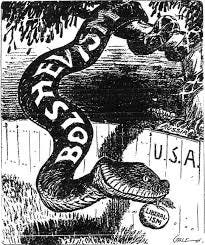
The media of many capitalist countries has often called Marxist-Leninist states “communist countries,” even though the government and majority of people in these countries have a common understanding that they are “socialist countries” run by a communist party. The reason for this common understanding is explained by the theoretical notion in Marxist-Leninist thought that communism is a future society in which class divisions among the people cease to exist. With class division (rich owners and poor laborers) no longer existing, it is theorized that money and the state itself, which enforces the economic rule of the ruling class, will cease to be necessary. In Marx’s analysis of history, he asserts that before class stratification (distinctions between rich and poor, intellectual and physical laborers, etc.), human societies engaged in what he calls “primitive communism.” Marx explains that these early human societies, which had no advanced means of production (things that help them produce goods), operated on a principle of “from each according to their ability, to each according to their need.” Marx believed that a revolution of the people rising up and claiming power for the working class would eventually create the conditions for human society to come back to this principle. Other socialist thinkers and later Marxist-Leninists began to describe socialism as “from each according to their ability, to each according to their work,” which meant, usually aside from basic needs, people were given wealth and resources proportionate to the amount of value their work created, basically a meritocracy.
The same capitalist media that usually calls Marxist-Leninist countries “communist countries” often attributes the label of a “socialist country” to countries like the Nordic countries that have strong welfare systems, which would more accurately be defined as social democracies.
Socialism vs. Capitalism
“Socialism” and “capitalism” are often described in contrast to each other, but sometimes what these two terms actually mean is intentionally or naively not part of this comparison. Political arguments over the two terms can turn into pointing at things that may or may not actually exist in a specific socialist or capitalist nation, then comparing them to examples from the opposing side and saying this is why this one is good and this is why this one is bad, ignoring the context of the events or phenomena observed and just looking for instant anecdotal proof of the morality of the ideas. Capitalism, however, is a specific economic mode of production (type of economic system) in which the freedom of private individuals to own the means of production (the factories, large-scale farms, apartment complexes, etc.) is established in law, where single individuals can be the autocratic dictators over businesses and even whole industries. The main difference between socialism and capitalism is the level of economic power that single individuals have over the economic lives of others. Socialism attempts to make production (what the society’s labor goes toward) a democratic process, while, in contrast, capitalism seeks to allow single individuals to determine the direction of production. Also, the capitalist is entitled (by law) to all of the profit the worker makes minus the agreed-upon wage for the amount of time worked; in socialism the wealth is democratically directed back into the pockets of the workers, into investment in the business or industry, or into the collective welfare of the whole population. The economic motivation of socialist society is for the collective benefit of all those who participate and the rest of the broader society; capitalism’s economic motivation is to get as much value out of the labor of others as possible while giving them as little as you possibly can, to increase profit and thereby the personal welfare of the individual.
The Illusion of Liberalism and the Imperial Core
As a citizen of the United States, I have heard the correlations of socialism and liberalism my whole life. Growing up in a very conservative environment, a small town in eastern North Carolina, I was told by my elders that liberals like Obama wanted to make the United States socialist, and that they basically were socialists. I was told that things like universal healthcare were socialist policies that would bankrupt our government and drive us into another Great Depression. The prices of everyday items, like a cheeseburger, would go up to 20 dollars and we would not be able to afford anything. With a new understanding that policies like universal healthcare in a capitalist system are a form of social democracy, it is easy to see that the extent of “socialism” that this would entail is very minimal compared to most other forms of socialist thought, if it is socialist at all. But what does the term “liberal” have to do with any of this?
“Liberalism” as an ideology arose alongside capitalism, as a philosophical justification for its policies and structure. Prabhat Patnaik, a professor of economics at Cambridge University who has many published books and articles, says,
“The evolving liberal democracies were typically accompanied by the evolving economic formation of capitalism; the political ideas and principles that make up the doctrine of liberalism are, therefore, deeply integrated with economic ideas about the nature of capitalism. My objective is to look at the notion of ‘freedom’ in the context of this integrated political and economic framework that we have come to call ‘liberalism.’ Liberalism is concerned with the freedom of the individual. Within liberalism, however, … ‘every strand of classical liberalism, whether or not it says so explicitly, must believe that the emergence of capitalism—that is, of the employer–wage laborer relationship, in so far as it has a history (and has not been a dominant form for ever)—was a voluntary process. And, since it is a voluntary process based on the freely given consent of all individuals, a competitive capitalist economy represents the only economic system under which individual freedom can be fully realized.’ ”
His explanation of liberalism’s role in presenting this “true freedom of the individual” as being inextricably tied to a capitalist system shows that liberalism is actually an ideology that produces and reinforces capitalism, not socialism. So why are they compared?
In the United States, the self-identified “liberal” party, the Democratic Party, has historically presented itself as having social democratic values. For example, FDR, a Democratic president from 1933 to 1945, was the president who signed the New Deal into law. This was a set of social democratic reforms which started unemployment and disability insurance, aid for families with children, government help with housing, and many other programs. This belief in social democratic ideals is what has continued to lure Americans into supporting the Democratic Party since. Liberal political parties in capitalist societies have an ideological goal of preserving the existing power structure that allows for capitalist rule over the working class. Due to political pressure or threat of revolution, however, these parties may choose to make a “deal” (like the “New Deal” reforms) with the working class: you continue to accept the rule of capitalists over industry, and we will make them fund safety-net programs that will ensure that even if you fall into poverty, there will be resources to help you survive, instead of just letting you become homeless and starve to death.
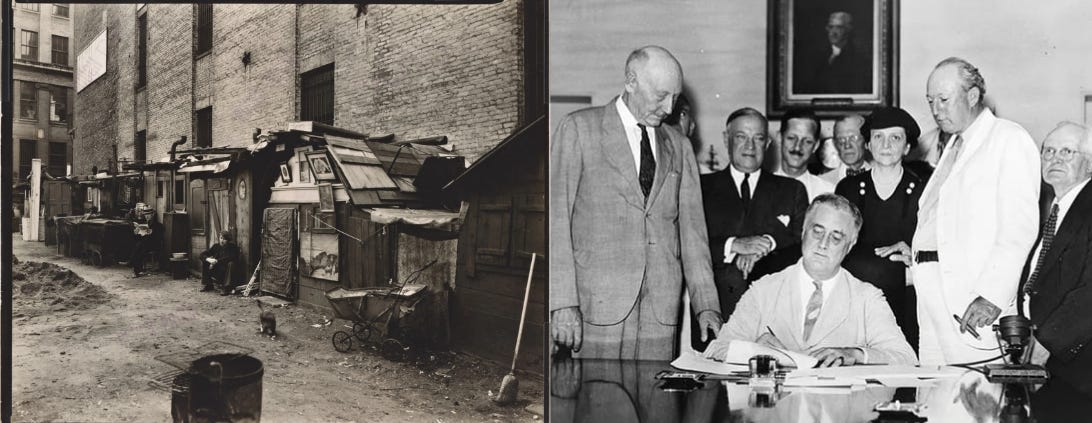
This aspect is not usually pointed out by these liberal parties, since it benefits them for people to believe that liberalism is just synonymous with the word “freedom” in general, like “freedom of choice,” “freedom to express yourself and be who you are,” and other commonly associated concepts. If liberalism is technically defined by the members of the liberal party, if it is explained how “liberal” means the freedom of one individual to be the autocratic dictator of a workplace or industry, then some of the supporters may decide they want to find a different ideology that actually challenges that.
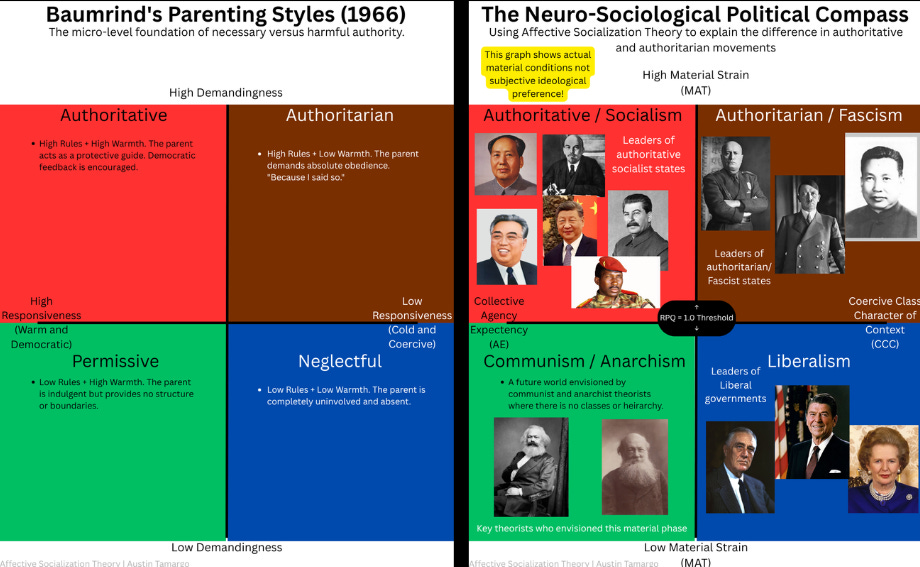
We can understand this dynamic even more clearly by looking at the updated empirical political compass of Affective Socialization Theory. Liberalism, as an ideology, thrives primarily in what we call the “imperial core” (wealthy, Western capitalist nations). Why does liberalism flourish here? It is a matter of objective material conditions. The imperial core artificially lowers its own Objective Material Strain (MAT-O) by outsourcing its poverty, exploitation, and systemic violence to the “periphery” (the colonized or historically exploited nations). Since the citizens of the imperial core experience relatively lower material strain, their nervous systems have the cognitive bandwidth to engage in liberal idealism. They can comfortably support a system that preaches “freedom” while remaining neurologically detached from the violence occurring on the other side of the world to sustain that freedom.
Conversely, when we look at the periphery nations, the material strain is engineered by capitalism to be devastatingly high. In these environments of extreme, inescapable scarcity, the population is structurally forced into survival panic. This high-strain environment creates fertile ground for opportunist authoritarian movements to take over. This is not to say that the imperial core is inherently “safe” and periphery nations are inherently “dangerous.” Rather, it is a strict neuro-sociological observation: when capitalism crushes a population with extreme material strain, it breeds authoritarian pathology, while the comfortable beneficiaries of that exploitation adopt liberalism to mask the violence.
Nazism, Fascism, and the Authoritarian Pathology
Because the German Nazi Party’s official name was the “National Socialist Party,” people who are either malicious or ignorant attribute Hitler’s “National Socialism” as just another form of socialism, when, in reality, the Nazi Party’s policies had nothing in common with what the word “socialism” had come to mean. The Nazi Party used the color red (which was the color most communist parties around the world adopted) and put the word “socialism” into their name, with the word “national” in front, to try to attract working-class members, and then, once these working-class people were in, tried to convince them that true socialism was the capitalist and working class working together, based on racial solidarity, to make their nation “great.” While the Nazi Party did have a stated goal of creating a “welfare state” for their citizens, it rejected the idea that there needed to be class struggle or any change of economic system, and it rejected international working-class solidarity, which is a socialist principle of recognizing that the workers of every country have more in common with each other than they do with their own national rulers.
In 1934, at the beginning of the Nazis’ political rule, Hitler and his allies in the party murdered other members of their own party who had stated anti-capitalist ambitions (which is literally, as we have discussed, what socialism actually historically meant: being anti-capitalist, finding a way to create a better life than what capitalism has given us) in what is called “the Night of the Long Knives.” They also banned other socialist or communist parties and imprisoned or killed many of their members. The only possible connection that could accurately be drawn between Nazism and socialism would be if we went all the way back to the beginnings of the conceptualizations of the term, which we discussed in chapter 1. Henri de Saint-Simon, an early thinker in socialist thought, believed that colonizing the world and forcing people to work was what would achieve a “better society” than what he perceived he had, but after this early discovery process of public discussion on what this new concept meant, it quickly became widely accepted that socialism was anti-capitalist. Identifying capitalism as the issue for the modern problems of society, early socialist thinkers then agreed that socialism would entail ending capitalism, or at least reforming it into something new. The Nazi Party did not only fail to do this, it protected and empowered capitalist corporations and did not redistribute wealth, despite promises of a “welfare state.” The following quote, pulled from an interview with Hitler himself in the 1930s, describes this, admitting that his government was trying to replicate fascism:
“Fascism offers us a model that we can absolutely replicate! As it is in the case of Fascism, the entrepreneurs and the workers of our National Socialist state sit side by side, equal in rights, the state strongly intervenes in the case of conflict to impose its decision and end economic disputes that put the life of the nation in danger.”
Fascism, the self-described ideology of the Italian government under the dictator Mussolini, comes from a Latin word associated with a ceremonial symbol of power. It was popularized by Mussolini and admired by Hitler. It is even said that Hitler wrote fan mail to Mussolini saying he wanted to be like him, and in interviews, he speaks about replicating fascism. But what is fascism in practical terms? What does it mean to do, what are its aims? To quote Mussolini directly, “The Fascist conception of the State is all-embracing; outside of it no human or spiritual values can exist, much less have value. Thus understood, Fascism is totalitarian, and the Fascist State, a synthesis and a unit inclusive of all values, interprets, develops, and potentiates the whole life of a people.”
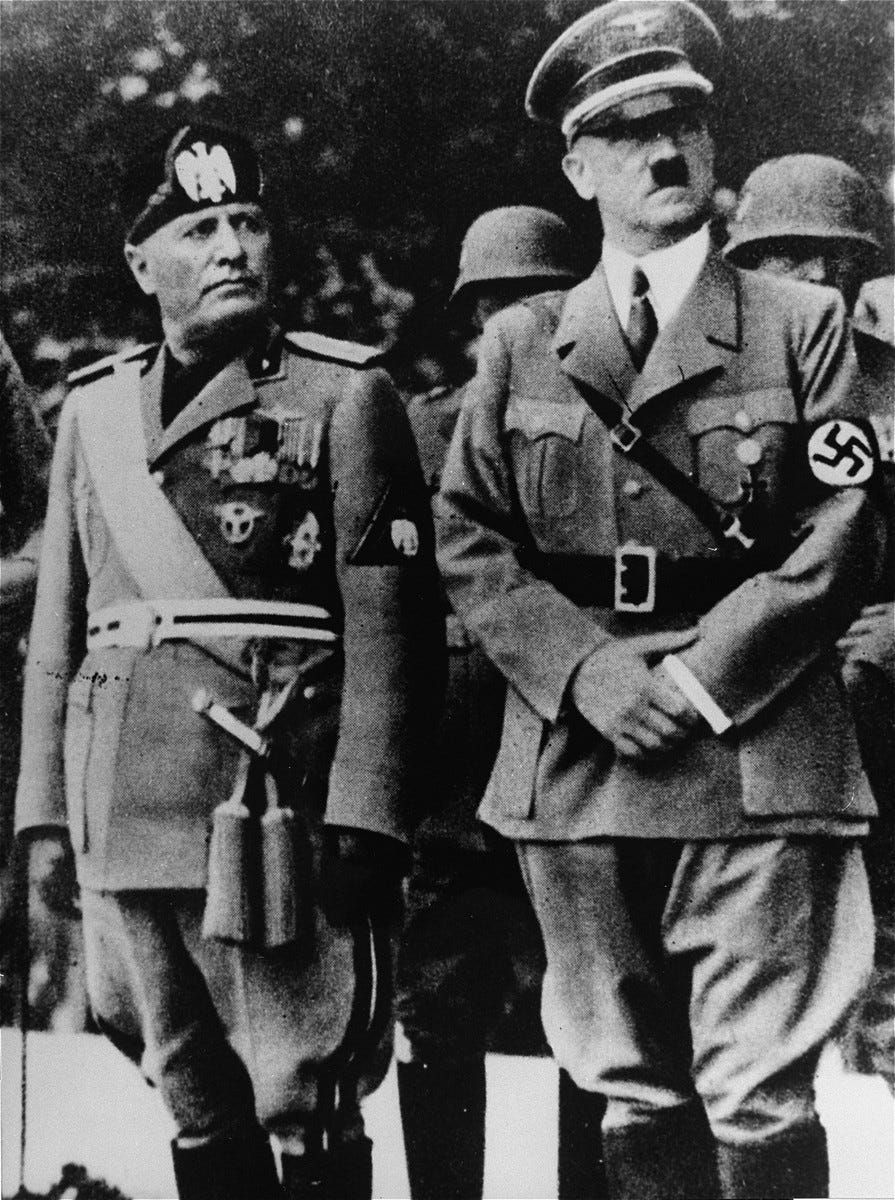
Mussolini describes fascism as being a totalitarian state, one that decides what things mean, one that attempts to mold the people into the shape it wants them to be by forcing a top-down violent suppression of any resistance to it. Speaking of totalitarianism, in anti-communist propaganda, I myself remember watching as a teenager and as an adult, fascism and communism are constantly presented as two sides of the same coin, both supposedly totalitarian systems that produce autocratic dictatorships and devastation for many people.
What is the actual difference between the socialist state and the fascist one, then? The answer to this seems to elude much of the mainstream media discourse on the subject, yet it becomes very clear when we apply the framework of Affective Socialization Theory.
The difference lies entirely in the distinction between an authoritative state and an authoritarian one. Fascism, like social democracy, is a response of capitalism in decline when citizens are threatening a revolution to take power for themselves. Instead of making a “deal” with the working class, a capitalist class that has chosen the path of fascism demands absolute obedience. Fascism is pure authoritarian pathology. It relies on high demandingness and zero responsiveness. It manufactures its own internal material strain to force compliance, demanding the working class not question or speak out about the political suppression they are witnessing, and demanding they continue to produce value to protect capitalist interests.
A healthy socialist state, conversely, is authoritative. It utilizes necessary demandingness to protect the masses from capitalist violence, while maintaining high responsiveness to the proletariat through democratic workers’ councils and mass participation. Not only do Marxist-Leninist socialist leaders not profess their ideology to be totalitarian, or to want to control the population for control’s sake, even the CIA apparently agreed that they were not an absolute autocracy. In a declassified CIA report on leadership of the USSR, it is noted: “Stalin, although holding wide powers, was merely the captain of a team and it seems obvious that Khrushchev will be the new captain.” This reflects the responsiveness required in an authoritative framework.
Speaking of totalitarianism, it is worth noting that Mussolini publicly admitted that fascism (his government’s ideology) was totalitarian. In anti-communist propaganda I myself remember watching as a teenager and as an adult, fascism and communism are seen as two sides of the same coin, both totalitarian systems that produce autocratic dictatorships and devastation for many people. However, not only do Marxist-Leninist socialist leaders not profess their ideology to be totalitarian, or to want to control the population, but even the CIA apparently agreed that they were not. In a declassified CIA report on leadership of the USSR, it is said, “Stalin, although holding wide powers, was merely the captain of a team and it seems obvious that Khrushchev will be the new captain.”
“Everybody Gets the Same”
Many people who are completely ignorant of socialism as a concept also assume that socialism means “everybody gets the same.” I say this from personal experience; I once even had a cop say to me, “that means that everybody gets the same, right,” when I had mentioned socialism. To some this may seem ridiculous to explain, yet my personal experience refuting people so uninformed and propagandized on the topic has taught me to be thorough.
As mentioned earlier, socialism has a variety of perspectives, none of which advocate actually dividing up the products of society equally among everyone. Many strains of socialism agree with the idea of “from each according to their need, to each according to their work,” a principle of meritocracy, not illogical, forced “sameness.”
Viewed through the lens of Affective Socialization Theory, forced sameness would actually be a rigid form of coercive demandingness. The actual goal of socialist economics is to structurally lower Objective Material Strain (MAT-O) below the critical biological threshold for every single citizen. By universally guaranteeing basic survival needs like housing, healthcare, and food, society stops the amygdala from forcing the population into chronic survival-mode panic.
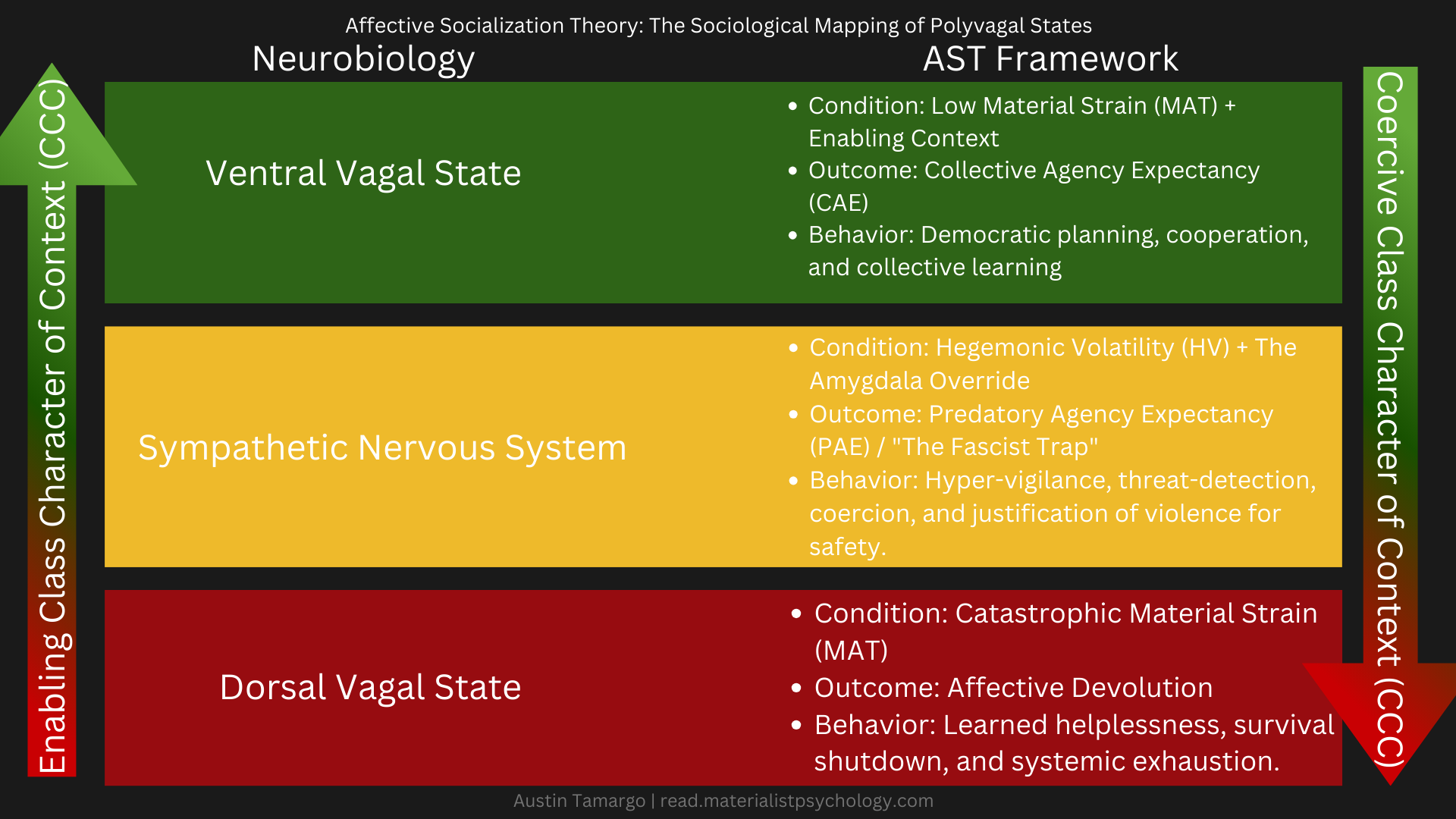
Once that secure material baseline is established, the nervous system can exit the Red Zone. This allows individual human diversity, high-level neuroplasticity, and Collective Agency Expectancy to finally flourish. Socialism is about equalizing the foundational environment to unlock diverse human potential, not flattening everyone into identical clones.
This concept often comes with the belief that socialist society does not have markets or businesses. It is as if some people hear the word “socialism” and imagine a dystopian society where everyone lines up to receive their daily allotment of goods that are equal to everyone else’s.
Why anyone would actually advocate for that, or be passionate about it, is something I do not know. I do know that now, after going through the historical development of the word “socialism,” defining its core principles, and looking at its distinctions from other concepts and misconceptions, an examination of socialism in practice can begin.
Coming Up in Part 6: Now that we have defined the core principles and cleared away the misconceptions, we will finally look at socialism in practice. We will examine historical and modern examples of Marxist-Leninist states, social democracies, market socialist economies, Maoist movements, and anarcho-socialist experiments to see exactly how these theories have been applied in the real world.
This article is a serialized, adapted excerpt from my book, What is Socialism? A Concise Analysis to Clarify the Concept. If you prefer to read the entire framework at once, or want to support this publication, you can [grab the physical paperback on Amazon here].
Also you can Dive into the full AST framework (still in development) on my website here: Affective Socialization Theory
References
Baumrind, D. (1966). Effects of authoritative parental control on child behavior. Child Development, 37(4), 887-907. https://doi.org/10.2307/1126611
Berlet, C. (2005). Mussolini on the corporate state. Political Research Associates. https://politicalresearch.org/2005/01/12/mussolini-corporate-state
Coaston, J. (2019, March 27). Adolf Hitler was not a socialist. Vox. https://www.vox.com/2019/3/27/18283879/nazism-socialism-hitler-gop-brooks-gohmert
Engels, F. (1880). Socialism: Utopian and scientific. Marxists Internet Archive.
Kołakowski, L., & Falla, P. S. (1978). Main currents of Marxism: Its rise, growth, and dissolution. Clarendon Press.
Marx, K. (1867). Capital: A critique of political economy (Vol. 1). Marxists Internet Archive.
Neammanee, P. (2025). Gavin Newsom calls Trump a ‘leading nationalist and socialist’ over deal that riled up MAGA. Yahoo! News. https://www.yahoo.com/news/articles/gavin-newsom-calls-trump-leading-183931922.html
Patnaik, P. (2024, October 25). A Marxist critique of liberalism: On capitalism and individual freedom. Economic Sociology & Political Economy. https://economicsociology.org/2024/10/25/a-marxist-critique-of-liberalism-on-capitalism-and-individual-freedom/
Resor, C. (2024, October 11). Capitalism, socialism, communism: Distinguishing important economic concepts. Social Studies School Service. https://www.socialstudies.com/blog/capitalism-socialism-communism-whats-the-difference/
Tamargo, A. (2026). Affective Socialization Theory: A unified model of behavior (Part 1: Neural wiring & the recursive system). Zenodo. https://doi.org/10.5281/zenodo.18514658